
Harry Fainlight’s The Spider is a poem in the way that Willem de Kooning’s paintings of the late 1940s are pictures. It starts in a room, with a speaker looking at the thread of a spider’s web hanging from the ceiling. But then all hell breaks loose, and the dangling thread (without an actual spider anywhere to be seen) spawns a whole host of monsters, beginning with an ominous quotation about what happens when spiders are fed a certain drug–is it the one the speaker has just taken? This sentence doesn’t hold still but rewrites itself twice as nonsense, nonsense full of smirking lewdness (Monsters 2 & 3).
Then the radiator throbs as if with a huge entrapped insect trying to get out, which reminds the speaker of the giant spider which his tape recorder became ‘last time’ when his voice shook a shadow on the ceiling like a fly caught in its web. His stomach throbs now and he longs in capital letters to vomit up a spider. He would feel better afterward and stagger weakly back up onto his legs and walk away, and so would the spider, in the very same phrases.

The poem is like one of de Kooning’s paintings in the way it is fragmentary, suggesting much and completing little. References tumble over each other and collide. Something like frenzy is the dominant mode. Certain forms in the painting are almost recognisable, borrowings from cartoons or other low sources, like the spotted dog sitting bolt upright in the lower left corner. The poem’s equivalent is elusive traces of familiar clichés. Which of the two is harder to pin down or be sure that one has comprehended? Could it be that the greatest feat of both poem and painting is to resist analysis and elude the reader or the looker in some deep and final way? De Kooning has an advantage here. His forms are inevitably more incomplete and more obscured by smudges and interference from nearby bodies than anything made of recognisable words can ever be. On the other side, the painting has the comprehensibility of being there all at once and thus not reliant on our keeping hold of parts which have already disappeared.
Harry and the spider are indistinguishable or not easily disentangled. He has an ulcer which is the centre of a web and wants to speak, vomit, be unraveled. The ulcer has twists like ‘this writing–the sick clutches of my signature… all its wrinkles of old age and tiredness that make a kind of brain—for what is a brain but certain muscles contorted into the stratagems of their tiredness. AN ULCER IS THE BRAIN OF COMMERCE.’
I have now got myself completely tangled in the web of the poem. I thought I could pick out a few of the threads and give a sharper sense of its movement than by external commentary. One of its most wonderful features is its lack of continuity, which also makes it hard to keep up with or describe. Its own phrases or its most insubstantial events seem to influence or determine what will happen next.
The ulcer has layers or ‘twists’, like the writing so far. Writing calls up handwriting, and your signature which is a form of you, which looks old because it is twisted or ‘wrinkled’ and not unlike the brain in layout, the brain now seen as the most contorted and inflexible of bodily tissue. This line of thought ends in a dreary capitalized aphorism, which almost swallows the speaker, who is saved by a series of lips breaking out on his hands, which might be able among them (as pronouncers of words) to think up a name for what is happening, which would help the speaker keep the first stab of pain to the scale of ‘a tiepin or the chirp of a bird outside, and not, or not yet the birth pang of this monster inside me kicking to get out’.
Giving birth is an overarching figure in the poem, seen most often as a hideous eruption, but the speaker can also imagine being born as an adorable young female spider or returning home as ‘a fat successful old spider.’ Contented visions are liable to turn sour, though, and sinking back into the ‘concentric pleasure of being a spider’ doesn’t last.
The Spider ends where it began, with the light bulb on the ceiling, which looks at him ‘like some Deva’s asshole—its rays just aching to be spread—to be opened out into some huge, gruesome Vision of the Universe, which common decency rightly forbids.’ It is typical of the piece that the most comprehensively gloomy statement picks itself up and relishes a final flippant flash of wit.
Now when it is too late I wish that instead of falling in too easily with the ragged style of the poem (much more exhilarating in the poem, which is in reality not anything so orderly as a poem), I had got serious about showing how thoroughly The Spider breaks down the continuity of the web and keeps the reader continually off balance with a series of devices I have left uncharted.
I’ve read this poem in a samizdat copy, so I am unsure about line divisions. I would like to include the entire text in the blog but have no permission to do this. I will try again tomorrow…
Willem de Kooning. Asheville, 1948, Phillips Collection, Washington

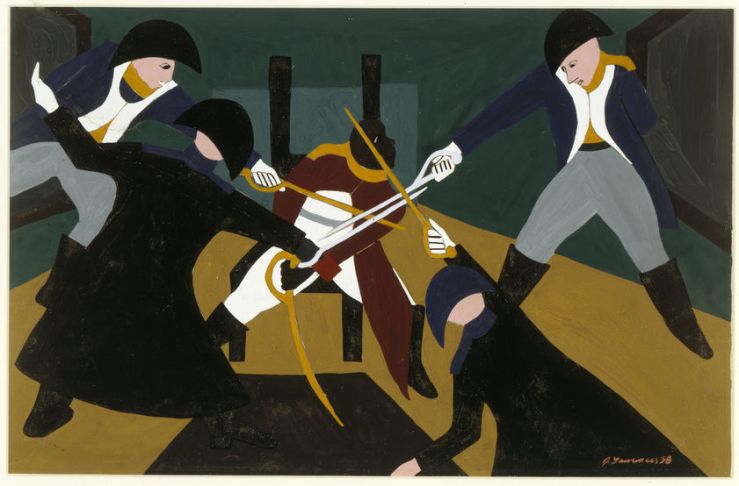 The paintings date from 1938 and are late fruits of the Harlem Renaissance. The artist, Jacob Lawrence, had been trained in the art school in Harlem established by the movement, had seen W E B Dubois’ play about Toussaint in 1934 and then researched the subject in the New York Public Library. The series started out as 41 paintings in tempera on paper. It isn’t easy to come by reproductions of the whole set; Lawrence supervised silkscreen prints of 15 of them he considered the best. The painted versions, each only 19 by 11 inches, were used to make the ten huge projections in the British Museum display. They must be something like 9 feet by 5 on the big screen, the size of a large Jackson Pollock, and they support the enlargement brilliantly and become truly heroic images.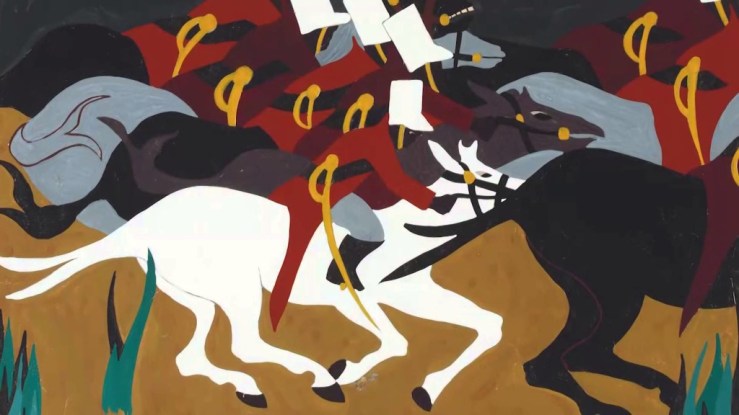
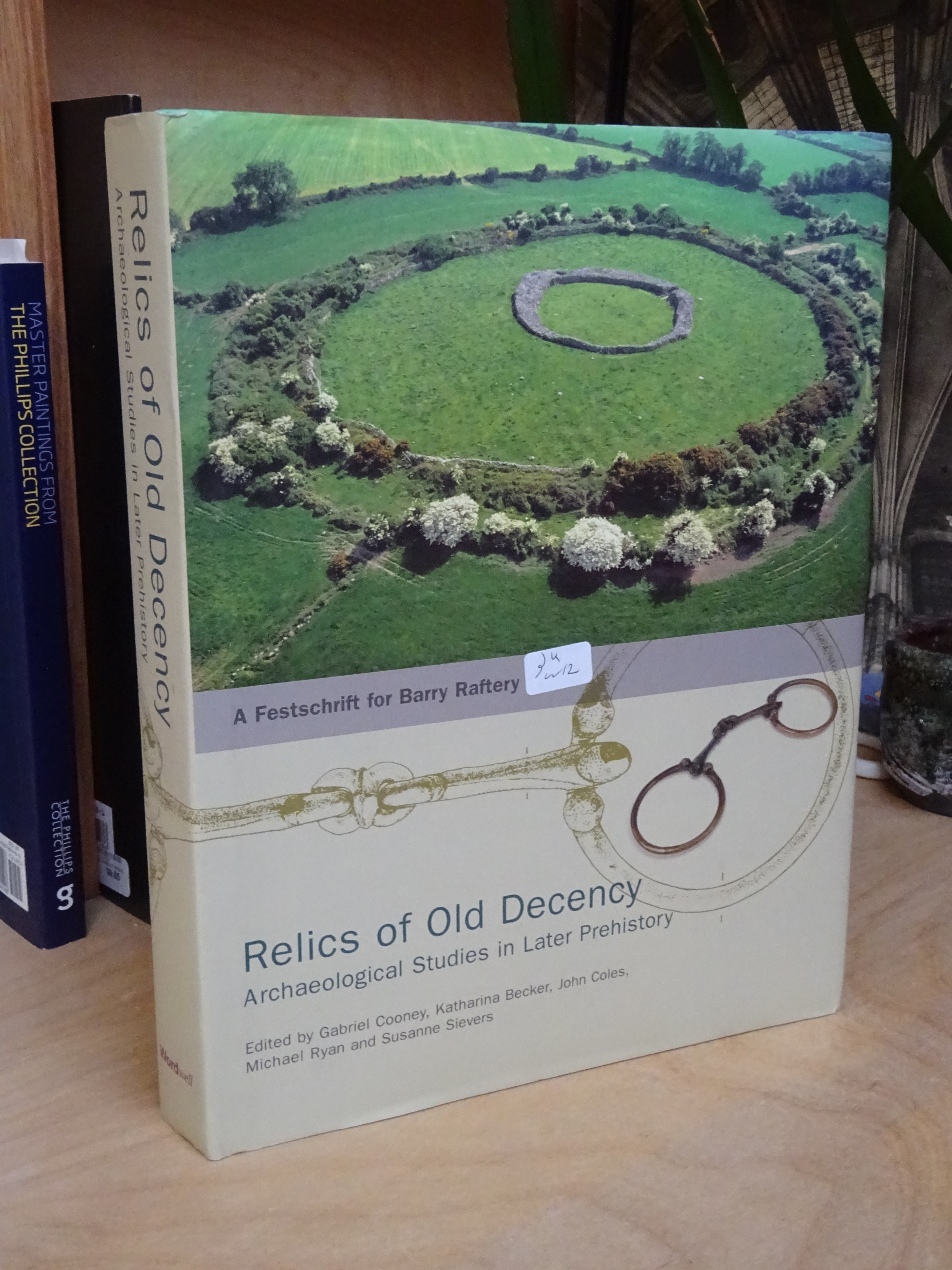 For the sake of these three pages of weird drawings I was prepared to put up with endless axblades and broken pots with hardly a figure or decorative pattern to be seen anywhere. But if I comb the book more thoroughly I will doubtless find more amusing drawings, of rudimentary creatures without heads but sporting prominent tails and penises and hands with five fingers of equal length, and of fanciful temples of classical type from long before the Romans drawn by Italian scholars.

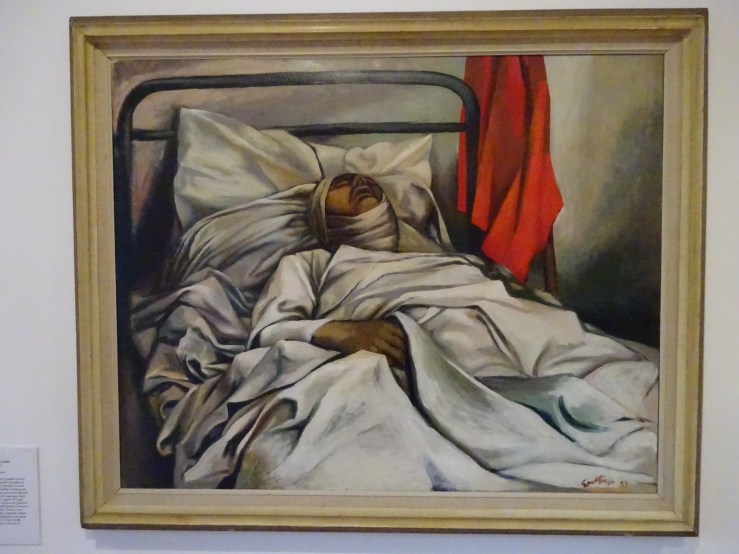
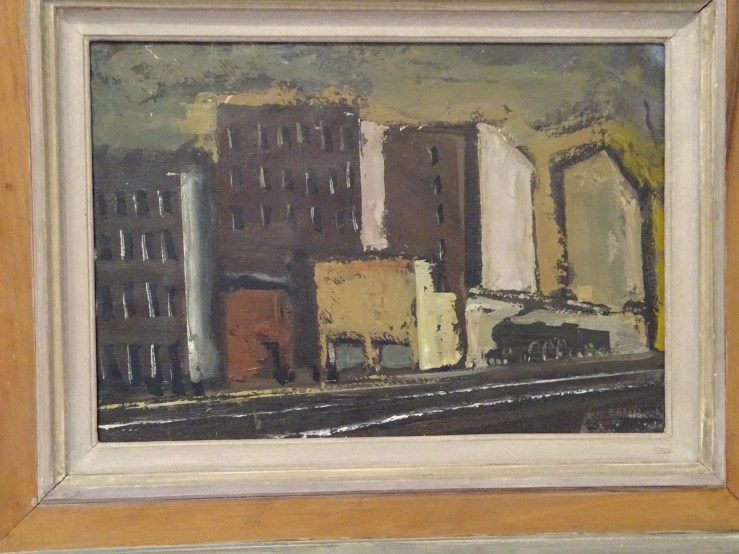 There are other Morandis, as well as the whole room of Morandi etchings and drawings from the permanent collection on the top floor. There’s another Sironi landscape of a desolate urban scene crossed by railway tracks with three promising industrial portals in the second Jesi room. This is matched by one upstairs, smaller and even bleaker. Two artists not included in the Brera selection, Medardo Rossi and Renato Guttuso, are also up there, permanently, the first in a richly grimed wax sculpture of a moment glimpsed in a city street, the second in a characteristically crude but gripping work, a dead proletarian hero in a hospital bed. Is it just my imagination or is Guttuso thinking of Mantegna’s similarly foreshortened dead Christ? Guttuso’s shroud is a riot of angular folds and colours—green, purple and ochre all lurking in the monotonous white of the sheets.
 The biggest painting in the second Brera room is Mario Mafai‘s Butchered Ox which shows two oxen rendered in what the label calls an ‘intensely expressive and emotionally painterly style.’ But I had to put Soutine’s much wilder versions of the same subject out of my mind to enjoy the abandon of this one. The catalogue prints Butchered Ox upside down. The tradition of inverting modern paintings, deliberately or inadvertently, is a venerable one.



 robert harbison's blog