

I’ve broken off reading Thomas McEvilley’s Sculpture in the Age of Doubt to write about British sculpture of the 1950s, acutely conscious how timebound those works look now. McEvilley’s book is twenty years old but seems timely to someone freshly drawn to figurative sculpture by Elisabeth Frink, Henry Moore and their contemporaries, who still seem haunted by the experience of war, whose work is perhaps rawer and more deeply undermined than that of McEvilley’s doubters of the 1970s and 80s. He writes about work by Iannis Kounellis, Marina Abramovic, Michael Tracy and two dozen others, which is sometimes only sculpture because it isn’t painting, or just because McEvilley wants to see Happenings and Performance Art as sculpture, which seems an unnerving extension of the territory to me, but might be a commonplace to more up-to-date observers of the current scene.
Has he thought out all that this extension implies? Probably, for he’s a philosopher, which is to say always looking to wider ramifications and perhaps losing sight of the visceral presence of the piece, this in spite of being extremely good at explaining complex works of art. So his preferred instances often involve the participation of the artist, who is cutting herself methodically and bleeding on her immediate surroundings, or incinerating a huge painting which has been carried to a watery location according to a special liturgy. These are works that leave little behind after the scene is washed clean by attendants or the weather, except photos, videos and written descriptions.
How dispiriting after such disruptions to turn to lumps of bronze which raise no doubts about whether they are sculpture or not, just questions about why they aren’t more carefully finished or more complete, which often show plainly that they started life as plaster, and which bear an obvious though mildly obscure relation to the human form. It worries me slightly that I am becoming newly interested in these works of art produced when I was a teenager, worries which really take off when I think of trying to interest anyone else.
The first Frink sculpture I ever saw, knowing it was hers, was an incongruous green Christ mounted high on the front of Liverpool cathedral. It didn’t fit and was too far away, much too high for its welcoming gesture to make any sense. My next Frink was also green but in a gallery, so it wasn’t the weather that had coloured the bronze this time. It showed an oldish man falling backwards, shielding his face with one arm, leaving both his feet sticking awkwardly up. He was on the floor, below eye level. I am not even sure whether he had landed already or was about to. I have seen him many times since, but am still not sure if he has landed. The effect of the figure depends on the feeling of something in the course of happening, and on the extreme vulnerability of the raised arm and flailing feet. He is still in the middle of the violence of his fall.

It didn’t take me long to learn from a label a few feet away that he was the work of Elisabeth Frink, a name I associated with dull public sculpture, and that he was called Dying King, apparently inspired by a scene in Shakespeare’s Richard III, where the great villain dies in the midst of battle, surrounded by his enemies. A bad man at his moment of greatest weakness—but it isn’t certain that this notion enters into our feelings about this sculpture.
What matters more is the rough hewn finish of the work. His shielding arm is a flat slab, like the outline of a form. His torso is eaten away by a natural process like decay, which isn’t decay of course, but a roughness and perforation that the sculptor has allowed to remain, rather than directly causing by a purposeful movement of her hand. The double nature of the material—so we need constantly to remind ourselves that these forms weren’t always metal, but something more malleable, even a runny almost-liquid for brief periods at least—is an endlessly involving feature of any bronze that lets its past as clay or plaster or even wood–Frink sticks on wooden slats to stiffen figures’ legs and doesn’t bother to hide them–show.

So the shrunken Richard is a tragic figure, participating in the instability of the world and of its various physical components, instability that cooperates with whatever it is in him that brings him down. He is part of a larger natural process and encapsulates more than one moment in the history of matter.
At this point along comes a little display of British sculpture of the 1950s in the big hall at the centre of the old Tate, spaces designed by the most retardaire of American classicists, John Russell Pope, an embarrassing favourite of mine. The first piece I notice is a fragment, a figure without head, arms or feet lying on its side. Its back is the most eaten away part, which is what I come to first. Again, as before, I am enraptured by the way the form is both there and not there, threatening to lose its shape from all the gouging, and intrigued also by the way the legs are broken off, as by a violent rending. The genitals telling you the figure’s sex are indistinct but big enough that you won’t miss them: Frink usually makes sure of that, for this is Frink of course, and called simply Torso.

 Next to it is another fallen figure who raises a little shield as he falls. His legs are pitifully shrunken, his torso misshapen like a rock which won’t bend itself completely to the human form. His head is more rudimentary than other Frinks, a stalk, an eye, a flat disk. I’m trying to take in the unmanageable variety of aspects I find in these forms, the great advantage of sculpture, that it can be a dozen different works in succession, depending on where you’re standing, or not standing but circling.
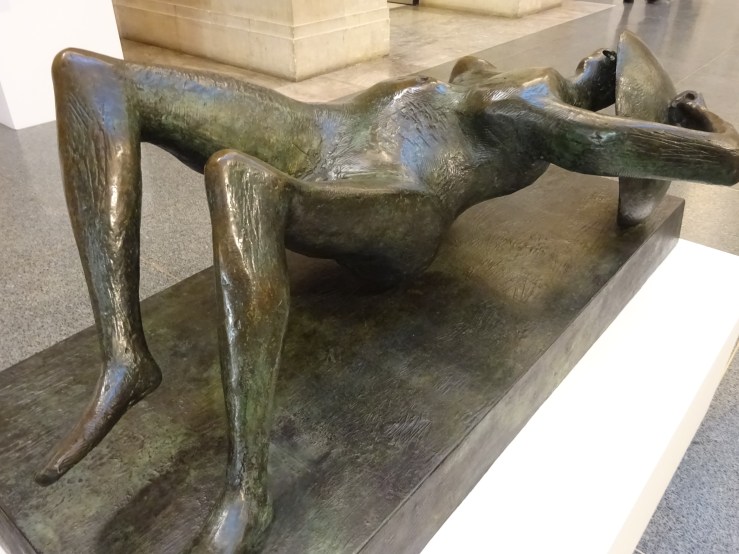
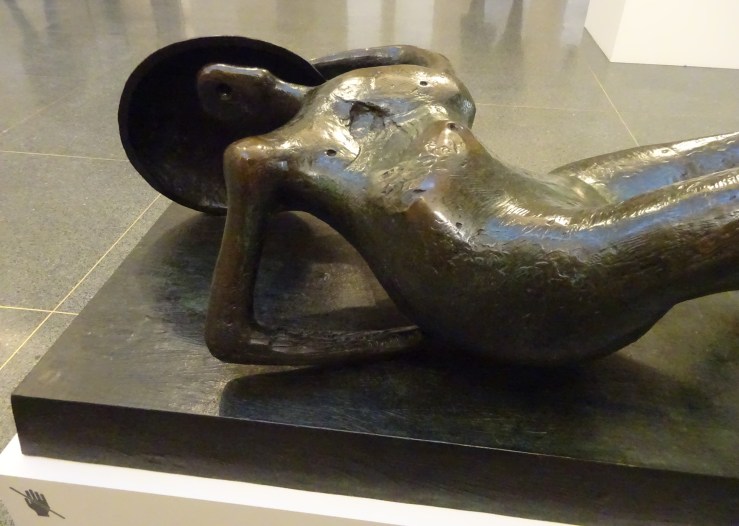
It’s a long time after, when reading about another piece by a sculptor new to me, that I find the label for the Falling Warrior, for that is his name, and it is important to the sculptor that this is not a corpse stretched on the ground but someone who is still alive.
The sculptor is not Elisabeth Frink, though, but Henry Moore. How could I have made that mistake? in which there’s a lesson, that you tend to see what you’ve come to see. I look at this warrior again and see something different, cooler and more composed, a less immediate rendering of violence. Now I view the two figures, Dying King and Falling Warrior as opposites, several rooms apart, but wonderfully comparable, versions of the same idea seen so differently by two sculptors who enter deeply into their subject and make something unforeseen that grips you too. And I don’t know which to prefer, ‘inflections or innuendoes, the blackbird whistling, or just after.’*
Opening image: In The Infield Was Patty Peccavi by Edward and Nancy Kienholz; metal, resin, cloth, wood, glass, paper, photomechanical reproduction, electric lights, stuffed bird and paint, 1981, Hirshhorn Museum and Sculpture Garden, Washington
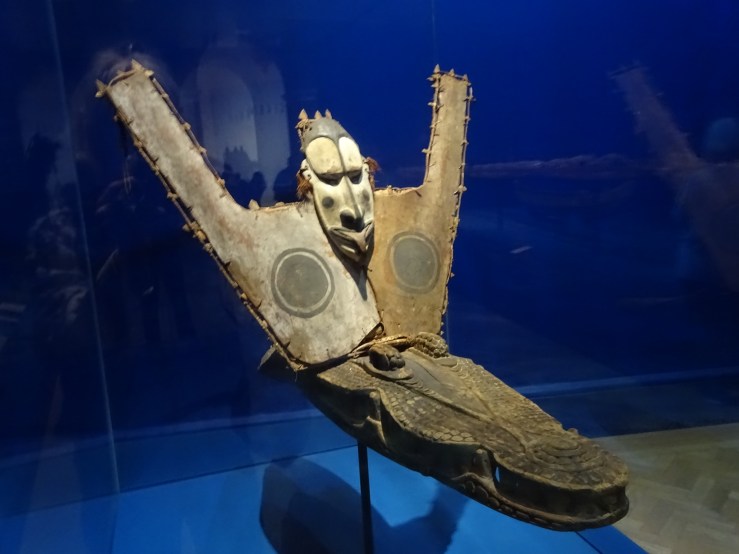
 Around them were grouped embellishments of canoes: splashboards inscribed with wave patterns that turn into birds biting each other, or a menacing crocodile prow with a demonic face on a canvas shield looming over it (see opening image). There were also three navigation charts like a cross between maps and abstract art, made of sticks (the main stems of coconut-palm fronds) lashed together into lattices dotted with tiny shells tied on in asymmetrical sequences. It’s the asymmetry and minimal means that make them feel like abstract art, and the diagrammatic arrangements of lines and dots that recall maps.
 Flimsiness, undependable materials and the prospect of a short life can also lead to delightfully casual effects, as they do in barkcloth masks stretched on light bamboo frames which are hard to control precisely. The resulting wobbliness of forms can look like beings who are changing shape before your eyes, as in the lopsided duck or bird above, who seems to make space for a large spider living on his forehead at the centre of a web that covers the bird’s face. Its enormous eyes are not used for looking at the everyday world but at something further off. The wearer can see only through the bird’s beak, which must give everyone, dancer and spectator alike, a dislocated idea of where reality will be found.
 Tattoos, and especially Maori face-tattoos, are indisputably an art-form, but difficult to include in an exhibition consisting of objects anchored in one place. There’s a remarkable drawing made in England in 1818 by a Maori artist suffering climate and culture shock. He depicts his brother’s face-tattoo as a single exploded view which flattens out the parts of the design that would disappear around the corners on the cheeks or over the top of the forehead. He makes it easier to grasp how this process consumes a part of the body and transforms it into a work of art, or rather how the body and the design are fused into a new being and a new work, a deeper idea of what writing lines on the body might achieve than most tattooists dream of.
 In 1896 a museum director in New Zealand solved the problem of how to display tattoos in a gallery that conveyed their vividness and power. He commissioned a sculpture from a noted Maori artist that would give him a three-dimensional rendering of tattoos. The resulting work looks as if it is carved from a single piece of dark wood left largely uncoloured to represent with defiant strength the darkness of native New Zealand skin. It shows three fully rounded heads emerging from a flat background deeply carved with traditional patterns, stained red and including two fierce birds with mother of pearl eyes. The heads are arranged in rows, two men at the top, a woman at the bottom. The men stare straight ahead, sightlessly; the woman looks down but her eyes are closed. You can study the tattoos as the director intended, but the expressions of the three and their asymmetries are unnerving.
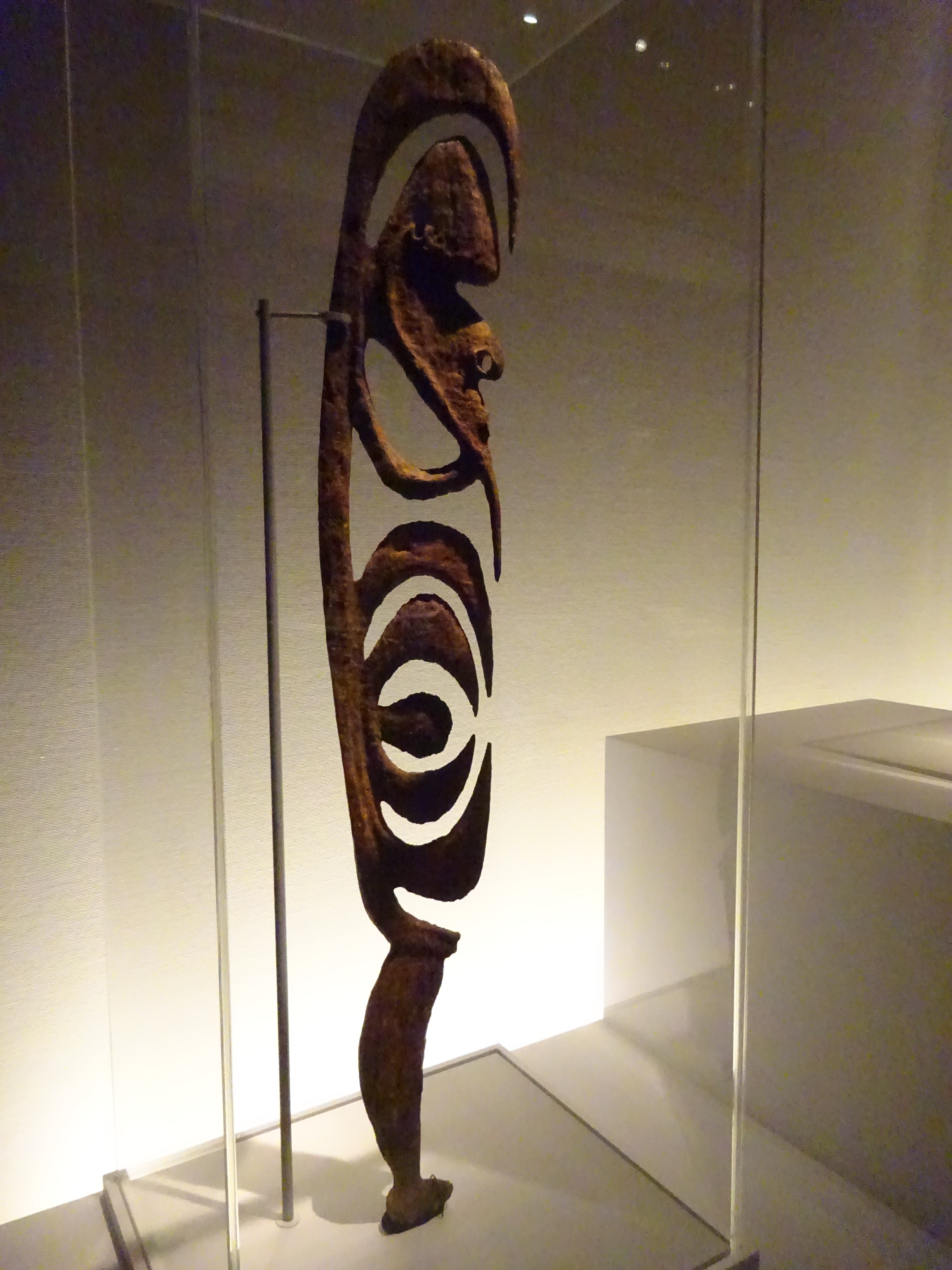
 There is often a strong impulse in Oceanic art to dissolve solid bodies and obliterate the distinctness of forms. One of the most perplexing works shows a human body become almost two dimensional, a graphic squiggle of concentric curvelets enclosing an essence receding toward the status of a dot. In a world without writing there is no letter C, but in a world with drawing there is certainly this empty but enclosing form of a shallow curve with more copies of itself within.
 In the same company belongs the astonishingly featureless figure from Nukuoro in the Carolines whose head is a spinning top like one of Oscar Schlemmer’s, spherical at the back, narrowed to the point of a cone at the front, its chin. I imagine that I see on this ‘face’ the most delicate concentric tattoos and even almond-shaped openings in the pattern for the eyes. From Tahiti comes another way of blanking out the person with strong shapes and textures, ones which do not belong to personhood, large flat pearly shells instead of face, hands and breasts; stiff rectangles of alien substances covering the rest of the body. Appropriately this is a costume for the chief mourner at a funeral, someone who cuts off from all connection while the ordeal lasts.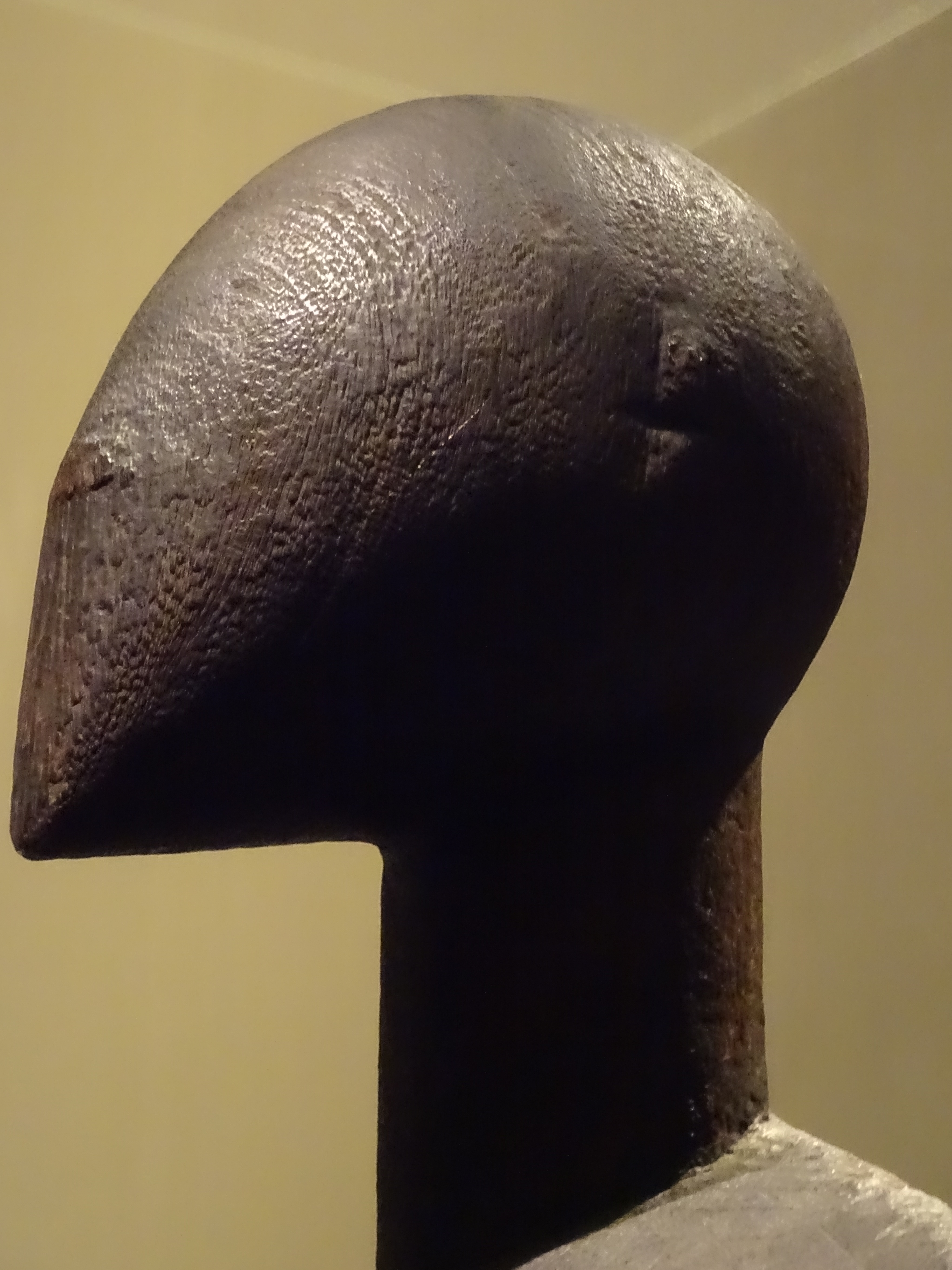

 A future assault might tackle the relation of Harry’s sad life to the poem. Is it, as I sometimes think, not just the record of a freak episode located in a moment far back in time, but an accurate picture of his mental life in the present? Or, more exactly, a sketch of what his life had become under the spell of the ruinous drugs he had needed to travel to New York to subject himself to?
 robert harbison's blog