
How to explain the extreme fascination of an exhibition which consists primarily of pages of writing, often illegible, in languages—Latin, Old English—no longer familiar. You don’t read the pages, but admire them, as feats of learning or curiosity, or industry, or survival.
It is an exhibition which replaces the idea of the Anglo-Saxons as mindless warriors, drunk in a mead-hall, with the idea of a rich intellectual and political culture connected in manifold ways to a wider European world and to places even further afield. Two scholars from Asia minor and north Africa were instrumental in breathing life into the monastery school of St Augustine at Canterbury. The image of the prophet Ezra above was left behind in Italy in the 8th century by an expiring English traveler on his way to donate the gigantic Northumbrian Bible in which it forms an illustration to the shrine of St Peter in Rome. Until modern times it languished under misidentification as Italian not Anglo-Saxon. Now it makes its first trip back to its place of origin, and the scholar surrounded by a proud display of his books can again stand for the sophistication of English culture in the 8th century.
The exhibition relishes the webs of connectedness to a wider than British world, webs partly lost and recovered by recent research, like the story of the complicated travels in France of the 8th c copy of Bede which spent a long interval in the cathedral at Le Mans before it made it back to England in the 18th century.

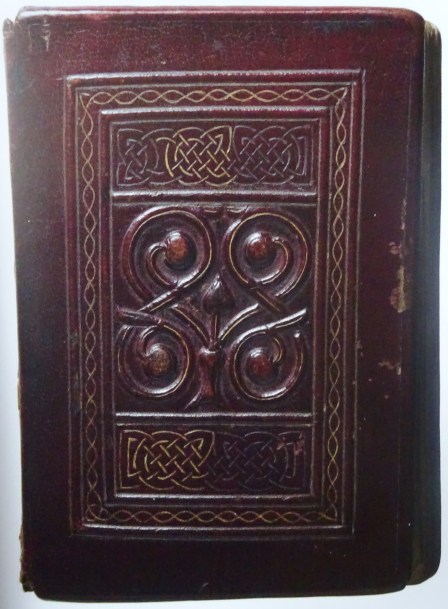
Earlier Anglo-Saxon exhibitions at the British Museum (in 1984 and 1991) concentrated on art; this one casts its net wider to include many humbler sorts of literate culture like letters, wills, charters and notes on the management of a farm, arriving in the end at an overwhelming sense of how much has survived from these centuries of supposed darkness. It makes all the difference that the evidence is so tangible and all there in front of you. The earliest letter to survive from the Christian West, from Bishop Wealdhere, is there, and the label involves you, with a wonderfully clear diagram, in the process of folding it four times so that it can be sent on its way to the Archbishop. Likewise the binding of the St Cuthbert Gospel, the oldest surviving binding of a European book still attached to its original contents, is dissected and explained in CT scans and diagrams that show how the delightful three dimensional relief of the cover is built up, using rope and cotton wadding. After all, it is this book’s book-ness, not its contents, which makes it one of the Library’s most important recent acquisitions. And so the symbolism of the apparently routine decoration of its cover seems important to penetrate, a tiny chalice whose presence might easily be missed, from which all the tendrils and bulging grapes of the sacrament grow.
 Recentness might also seem to count for too much in some of the most venerable exhibits, like the Binham Hoard or the Harford Farm Brooch, both named for the spots in Norfolk where they were dug up. In the series of recent finds we see the soil of England continually yielding up signs of the Anglo Saxons, and making us feel that they are in some sense still there.

The Cuthbert Gospel was buried with St Cuthbert in the 7c, rediscovered when he was exhumed in the 11th century, but only entered wider public consciousness in 2012 when purchased by the British Library. So in its way it is newly re-exhumed, because newly connected to the present. Likewise the Harford Farm Brooch, not so unlike other brooches found elsewhere, is unlike them in touching us more closely, because no one before now could have known it. The catalogue tells me things about it that I didn’t notice in front of it, that it was clumsily repaired, with what had seemed a pretty good imitation of interlace in gold wire until it was pointed out that it doesn’t quite fit. Nor could I detect that the repairer (or botcher) had the temerity to sign the back of the brooch. I particularly liked the crushing or crinkling of the Binham bracteates and only learned from the catalogue that these were not the ravages of time, but deliberate defacements by the burier.
Both the brooch and the bracteates seem special as works of art, the brooch for the second subliminal cross at 45 degrees to the main one, which sets the design spinning; the bracteate for the faint and distorted embossing which is not, as I thought, the crucified Christ slipping downward from the grasp of God who supports him, but a skinny figure who fights a creature with a big beak.
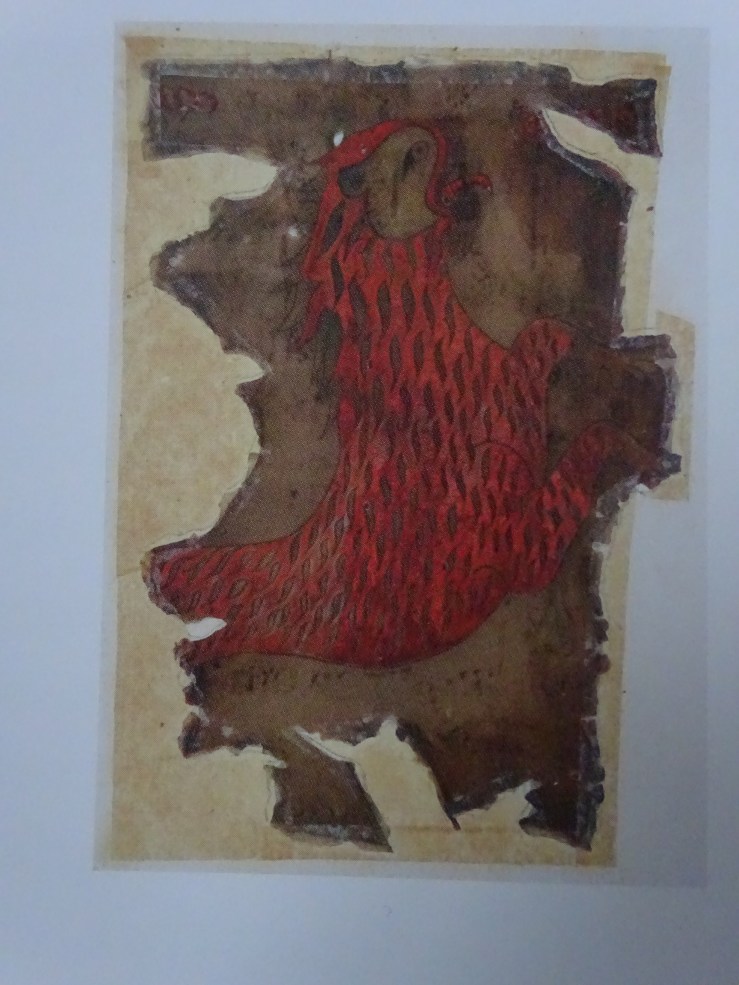
Among the most moving survivors of the centuries are manuscripts which suffered in the fire in Sir Robert Cotton’s library in 1731, including the only known text of Beowulf, the magical Old English epic which combines pagan monster tales from a dim Germanic past with an overlay of Christian introspection. The most wonderful survivor, visually, of that fire is a fragment of a rampant lion, avatar of St Mark from a Northumbrian Gospel* of c 700. To appreciate how precious this remnant is, you really need to start with the intact eagle representing St John from the same manuscript, displayed next to the lion in the exhibition, but luckily separated from Cotton’s fragment before the 18c.

These animals are sometimes shown as diminutive mascots of their Evangelists, as in the Lindisfarne Gospel’s four portraits, or in the little ox perched insecurely on St Luke’s halo in St Chad’s Gospel from Lichfield, one of the most delicate and whimsical in the exhibition. The animals by themselves represent a more primitive and forbidding style of author-portrait, at their most savage over the doors of French Romanesque churches like the abbey at Moissac. The eagle in the manuscript is threatened (or protected, the common view), hemmed in and temporarily tamed by crosses coming at him from every direction, a vibrant image of a stand-off that combines the love of hypnotically repetitive pattern with the clarity of carefully deployed emptiness.
We can only guess how the lion was bounded. It looks as if the arm of a cross may survive to the left of him, so he may be set against an abstract but symbolic pattern of lines like the Echternach lion in a case nearby. The catalogue, one of the best in recent memory, interprets both images brilliantly. Bernard Meehan, the writer of this entry, detects a distorted cross in the maze-like set of lines from which the Echternach lion tries to jump free, and in the Cotton lion’s coat he recognises a pattern like flames, a fire that still smoulders in the fragment, scarlet emerging from deep brown.

Through a wonderful initiative of the British Library, these manuscripts have become much more visible, digitised at high resolution on the Library’s website, so that now you can examine every page of them, not just the ones the books happen to be left open on for the exhibition. This includes all five carpet pages of the Lindisfarne Gospel (a detail from one of them above), five incipits, four full-page Evangelist portraits and all the pages in between. It is wonderful to see how transparent the colour is in all the tangled beasts on these pages and how feasible it has become to trace your way among the tangles as if the books were your own.
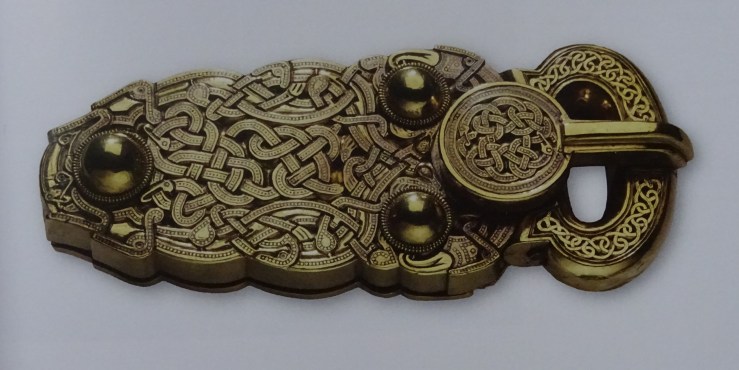 The best or the worst tangle in the exhibition occurs on the famous gold belt- buckle from Sutton Hoo, appropriately because a buckle makes knots in a belt unnecessary, so the buckle is free to illustrate knots of insoluble complexity. The catalogue likens the Anglo Saxon taste for linear intricacy to the love of riddles, and praises the goldsmith for his clever devices for sorting out the puzzle. The buckle apparently depicts 13 bird-headed, snake-bodied beasts at three different scales, four of which are used up in the hook and clasp, leaving 9 for the main plate, where the writhing bodies are distinguished by different types of beading (only two of these, not nine, as far as I can see). I am left wondering whether this buckle is a riddle with or without a solution. I see the animals’ bodies and once in a while their paws, but not their heads, which have become so minimal they’re more like paper clips than animal parts, so that identifying them gives no pleasure. Perhaps this is the final test of a taste for puzzles: you need to like the ones which can’t be solved.

In 1984 the Aedwen brooch, now named for its owner rather than its find-place, was scorned as an example of degenerate interlace, a tangle which couldn’t tie up its ends. Now its late, loose character seems its main appeal. It no longer ‘degenerates toward virtual abstraction’ but frees itself from restriction and produces a novel, shredded rendition of interlace, drawing further attention to itself for including a curse on anyone who steals it.

Finally, there’s an example of falling out of love with the interwoven style of the eighth century where so many of the best works in the exhibition are at home, played out within the pages of a single manuscript. It’s an Irish ‘pocket’ gospel, one of those convenient little books meant for one person. It now contains two versions of the author-portrait of St Luke, the first (8th c) hieratic and staring straight ahead but in mellow colours–wine, ochre and pale green, the second (10th c) more turbulent, whose saint is seen busily writing while sitting on the roof of a small building, overshadowed by his ox-avatar looming up from a novel cloud-substitute, a tangle of draperies like a thunderstorm. The artist is carried away by his enthusiasm for the rampant linen foliage that threatens to squeeze out the saint. It’s like a miniature reprise of the lush manuscripts of the school of Winchester like the Benedictional of Aethelwold, which formerly charmed by their exuberance but now seem to promise only a plague of acanthus filling every empty space.

You don’t need to share my preference for the earlier phases to appreciate the depth and connectedness of the thinking embodied in this exhibition. It sets off from the Spong Man, a little clay figure or miniature Thinker with his head in his hands, now separated from the funeral urn he formed the lid of. It ends five centuries later with survivors which are even more unlikely, notes on farm management in the Isle of Ely that needed to be dismembered in order to be saved, by being concealed as stiffening in the bindings of later books. The miracle of the exhibition is to weave the odds and ends that survive into a compelling narrative, where famous treasures like the Fuller Brooch and the Alfred Jewel come to fuller life by casting light on each other. They were already beautiful; now they are alive.

*The Otho-Corpus Gospel, code for the two owners: Otho from Cotton’s classifications for his books by classical busts, mainly Roman emperors, who sat atop his bookshelves, Corpus from Corpus Christi College, Cambridge (via Archbishop Matthew Parker, a great 16c collector)
Anglo-Saxon Kingdoms at the British Library, Euston Road, London NW1 until 19 February 2019



 robert harbison's blog