Beardsley the modernist

4 8 neophyte and how black art was revealed copy.jpg

The big Beardsley exhibition at Tate Britain was the first major exhibition that the virus kept me from visiting, and I got the idea that, using Linda Zatlin’s catalogue raisonné, I could stage a more comprehensive exhibition at home.  So I buried myself in her giant volumes and saw a lot I hadn’t seen before.  That was five months ago. Now the library has finally recalled Zatlin and sent me back to the topic from March.

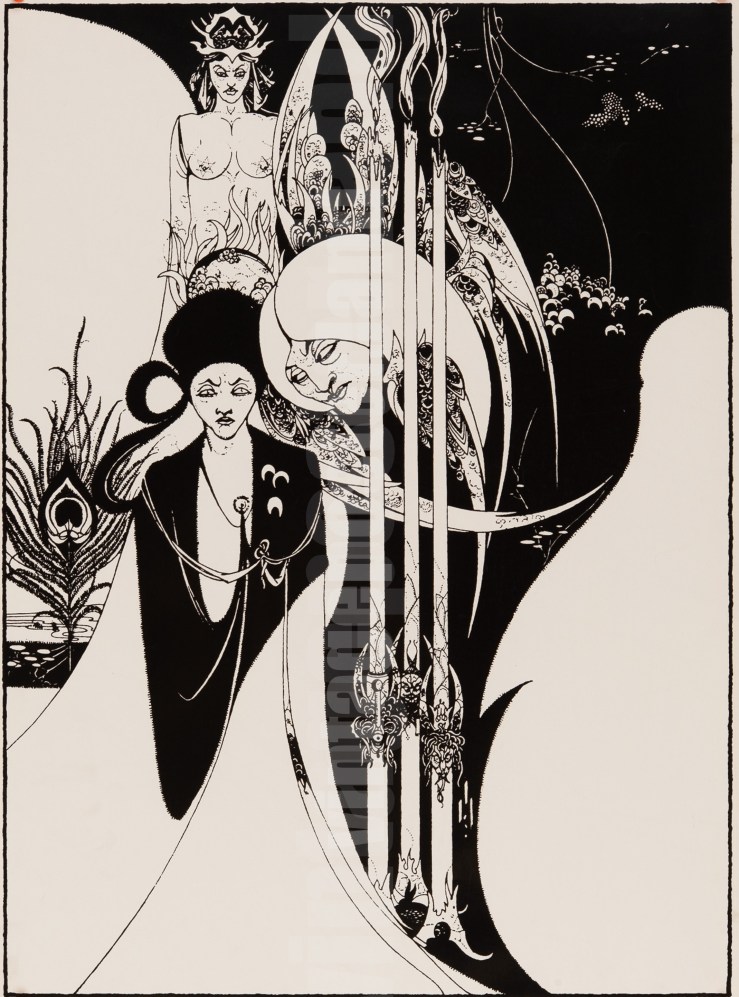
Beardsley the Modernist, Beardsley the Pornographer, Beardsley the Puritan, Beardsley the Decadent, Beardsley the Teller-of-Stories or Beardsley the Burier of Secrets.

These strange appliances that continually recur, they must mean something else, because they are so exaggerated. Impossibly spindly candles burning away above the characters’ heads, consuming their own substance without end. They must be emblems of the temporary in spite of their inhuman stiffness and their appearance in phalanxes of three, impossibly near each other.   Beardsley learned that he had consumption, the nineteenth century name for tuberculosis, when he was seven.   He died eighteen years later in the South of France, a Catholic convert who sent desperate pleas home to burn his wicked work, which his friend and publisher disobeyed.   His room in France was a shrine to Mantegna above all, one of the most secular of classicists. His religious pictures are feeble. His favourite Gospel story, Salome’s unsatisfied passion for a saint she couldn’t corrupt (until death did it for her) was a favourite with Symbolists, who wrenched it away from the very idea of abstention. Beardsley’s drawings purporting to illustrate Oscar Wilde’s play, several of them completely re-thought to outwit censorship, had been calmed down perhaps, but were still lewd, if less directly.
1 j'ai baisé drawing 265 copy

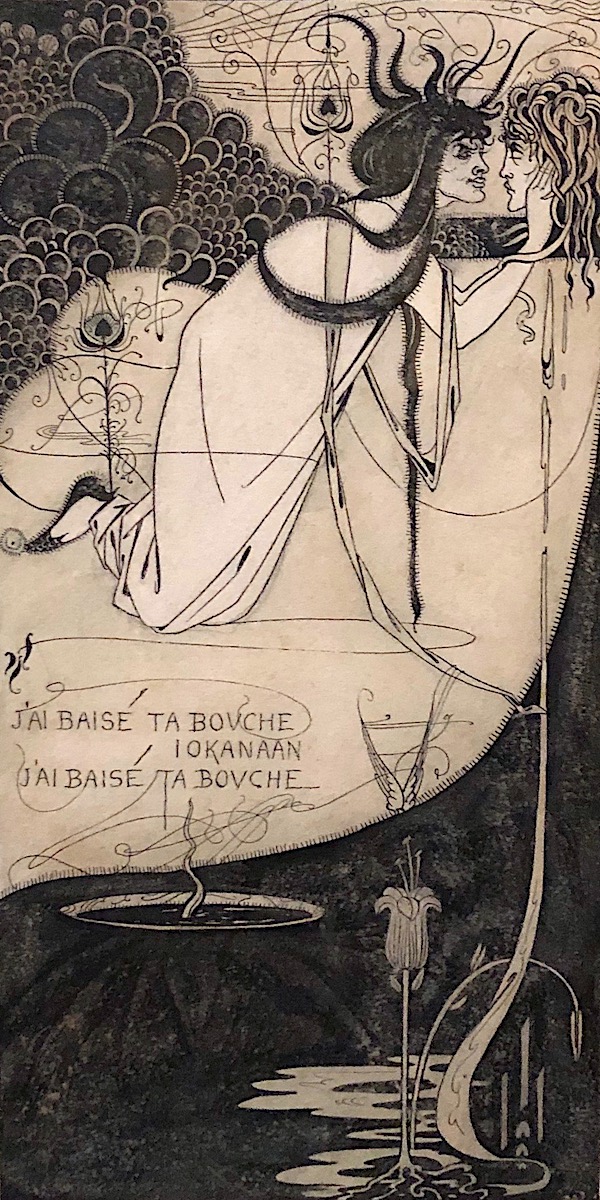
How can it be that this grisly, even necrophiliac subject pushes Beardsley towards a purely two-dimensional abstraction?   One of his most revealing remarks, quoted by Linda Zatlin (who produced the invaluable catalogue raisonné) from an interview in the Boston Evening Transcript (previously familiar to me only via one of T. S. Eliot’s jokey early poems), was that his works were just as good when you turned them upside down.   Early abstractionists have described being pushed further by seeing their own designs upside down. Beardsley was trying to de-toxify his work with this suggestion and making a claim to seriousness for Art’s sake. I took him up on it and spent an inordinate amount of time holding Zatlin’s volumes upside down. This works better with some than with others. Seeing growth hanging down instead of sprouting up can be invigorating. Some of the temporal dislocations in Strauss or Debussy feel like musical phrases turned upside down to echo a character’s alienation.

Beardsley is a radical and perceptive theorist of line who realises what he is doing when he prescribes that you should maintain the same thickness of line both in foreground and background, rather than getting thinner as you go further away. It sounds like a narrow point, but he is discarding illusions of space for the realities of the picture plane.
2 The_Apparition,_Gustave_Moreau_1876-2 copy.jpg

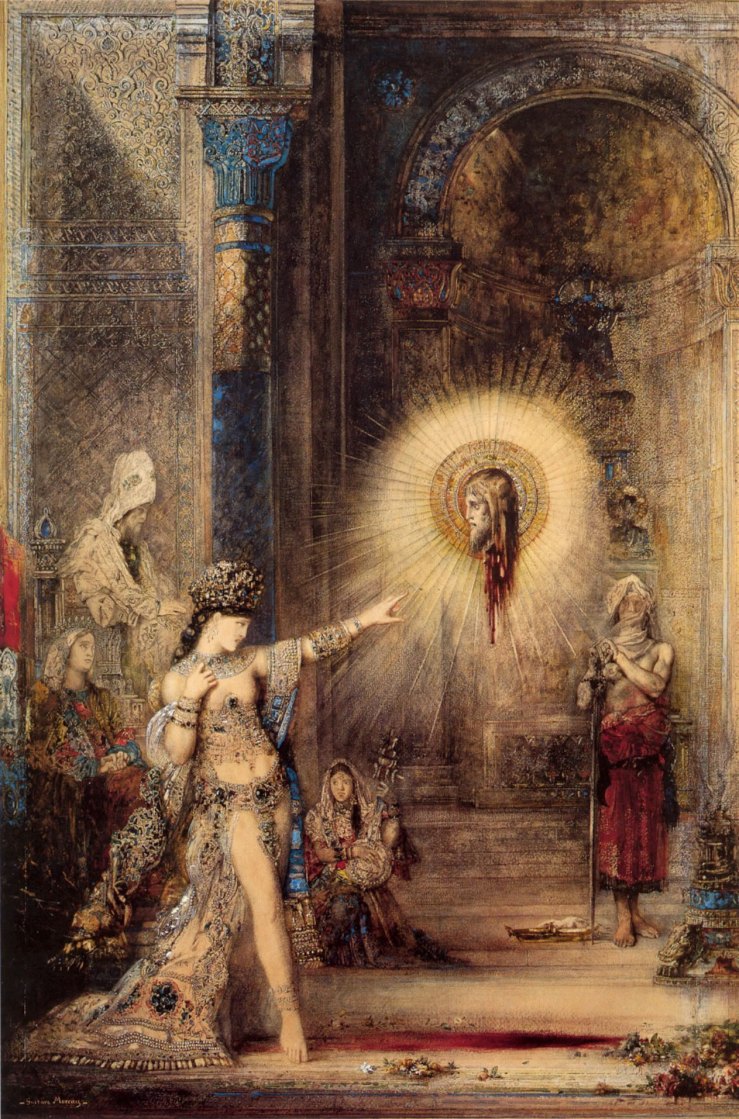
Yet who has ever managed to look at Beardsley primarily as a formalist? Fifteen years before Beardsley, Gustave Moreau had been obsessed with the story of Salome in a whole series of paintings and watercolours of mesmerising richness, where a small company of onlookers provide sub-focii in the dense forest of detail, tile-covered walls, mosaic-encrusted vaults and flesh inlaid with jewels, from which Huysmans got the idea of planting gems in a live reptile’s shell, which would then grow around them, a description perhaps of the relation between characters and setting in Moreau’s frozen tableaux.

3a  climax cream beardsley-aubrey-aubrey-B20139-97 salome 15 copy.jpg

At this point in his career Beardsley is stripping away detail from his narratives. In a mechanically reproduced form of the drawing much of the filigree has to be sacrificed to pure line and pure contrast, black and white and nothing in between, where both became stronger in this poverty or isolation.

Something became stronger but it wasn’t the bodies of man and woman. In this Beardsley composition Salome is a ghost, and Jokanaan a metaphysical phallus, a candle flame burning itself out and a liquid dripping into a lake where it remains on the surface like an oil slick or the design on a carpet. Mysteriously it inspires growth, an erect and a wilted version of the phallus which seems to be the story of Jokanaan telling itself over again.
3b head on pedestal beardsley-aubrey-aubrey-B20139-96 salome 14 copy

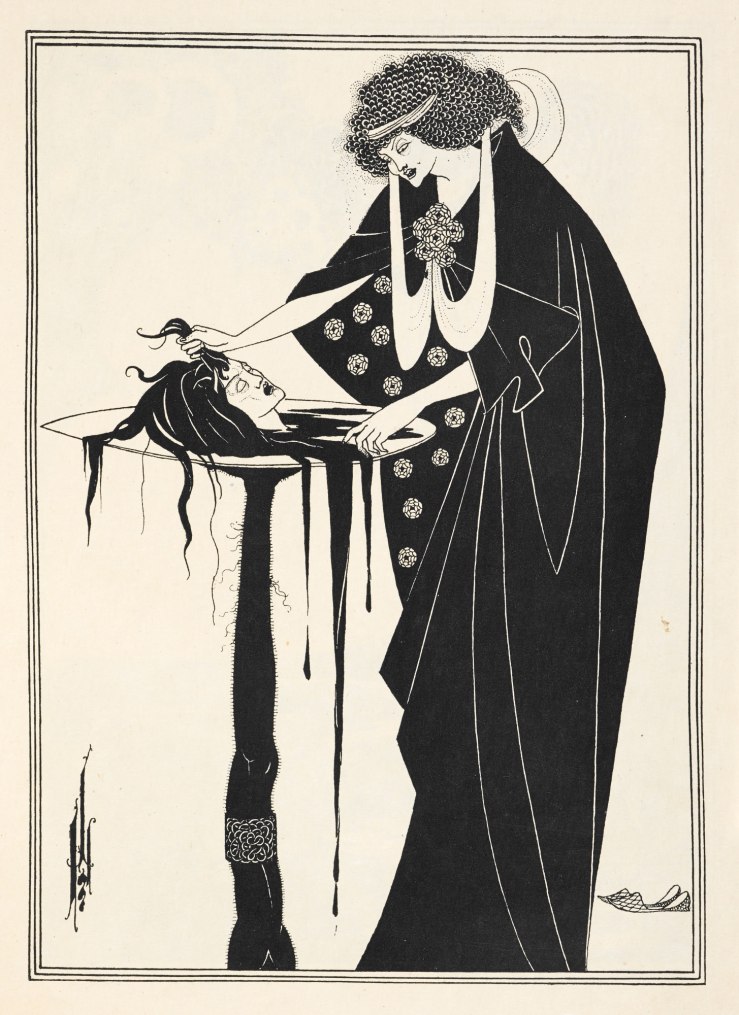
This confrontation of the levitating woman (orgasm? the illustration is called Climax – or is that just my name for it?) and the decapitated head – the essence of the man, or an utterly emasculated form?   This is a confrontation that goes on occurring–next time or the time before he is presented on a platter like a dish you could consume, but at the end of a hairy post, so another phallic terminus, and now there is nothing delicate about the effusion of liquid, it’s a dark mess spilling off the edge in more than one direction.
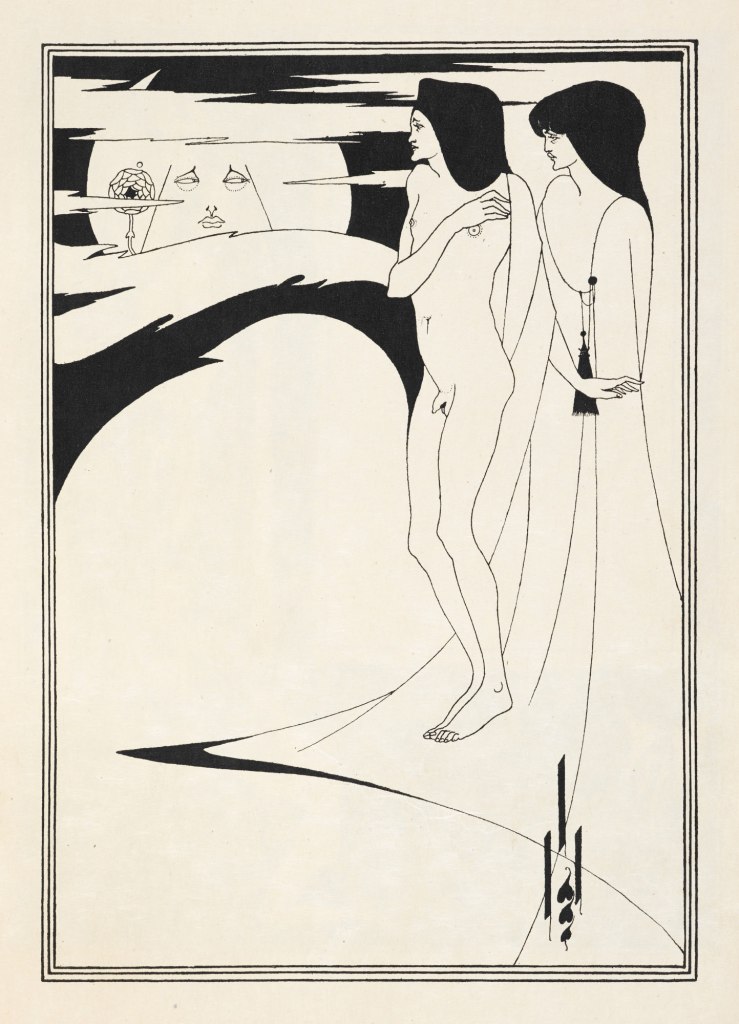
5 beardsley-aubrey-aubrey-B20139-83 salome 1 copy.jpg

I thought I had to begin the story at the end because that is where Beardsley began it, but there is a sense in which these episodes do not take place in ‘real’ or ordinary time but in a world of archetypes which all exist at once. So you have a couple looking at the moon who has the features of Oscar Wilde (their author?). Are they John and Salome? They both look utterly inexperienced, like frightened children who hesitate.   Male underdevelopment often takes the form in Beardsley of childish genitals which seem to signify somebody who isn’t ready to embark, a spiritual as much as a physical condition, and hard to connect with Beardsley himself, however much we try, who was well on his way to producing over a thousand separate works in a career that lasted six years, much of which must have been spent in devoted labour.

6 beardsley-aubrey-aubrey-B20139-91 salome 9 w figleaf copy

As the moonscape is empty, this one is full, full of contending forces. Wilde is there again as a weird priest or impresario with the owl of wisdom functioning as a tribal headdress, ending in horns (a joke? Beardsley seems to treat him as fair game).   Herodias is bigger than the others who exist to serve her, including a foetus with what critics take for an unsatisfied erection pushing up through his clothes–if so, the most economical lewd reference ever.   Beardsley’s fascination with elderly foetuses must have a neo-Platonic explanation, the soul’s pre-birth and corruption occurring simultaneously.

Zatlin always plumps for Beardsley’s seriousness but goes on finding little erections all over the place, as if there could never be too many. Kenneth Clark surprises us with almost moralistic disapproval of Beardsley’s fascination with corruption. I can’t help seeing Beardsley as a kind of troll, offending Victorian sensibilities so plentifully that many references will escape. The effeminate creature who sports a vine-fig leaf formerly possessed a typically shrinking cock with feeble pubic hair. He got curtailed, while the delicate penis-candlesticks got waved through.

7 toilet beardsley-aubrey-aubrey-B20139-95 salome 13 copy.jpg

The Toilette which follows is one of the outrageous ones and was replaced by the most abstract and severe, without the bystanders or the upsetting jokes. Here exquisite appliances lend themselves to suggestive acts. The long tall extension of the stringed instrument, the strange dripping forms under the left-hand boy’s seat, the glances exchanged or not exchanged by the two nude boys, one with pubic hair and a hand that doesn’t look innocent – there’s all that ‘activity’, and then the amazing emptiness of Salome’s clothes which are no more than two extra-thin lines making a bounded place in which nothing is allowed to take place. These disparities are rich with irony and an almost philosophical appreciation of the void. The distancing around Salome and the coiffeur, who mixes hints of bats (his mask) and spiders (his hands), creates a whole other world.
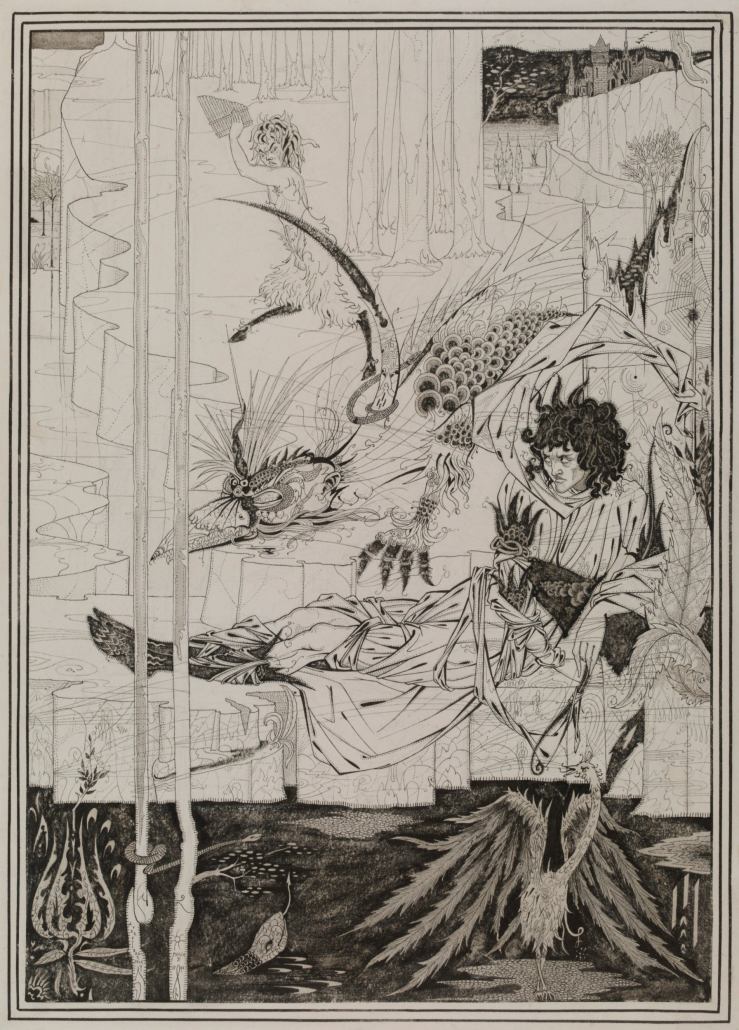
8 beardsley how arthur saw questing beast 424 copy

Arthur and the Questing Beast is a step back into a different and earlier world still working itself free from William Morris and Burne-Jones’s medievalism and an earlier Victorian love affair with the Middle Ages. Beardsley’s drawing shows an encounter between a knight and a dragon, as you’d never guess, or not quickly, and not a heroic but an entangled one, which you settle into disentangling, which has set a hundred traps for comprehension.

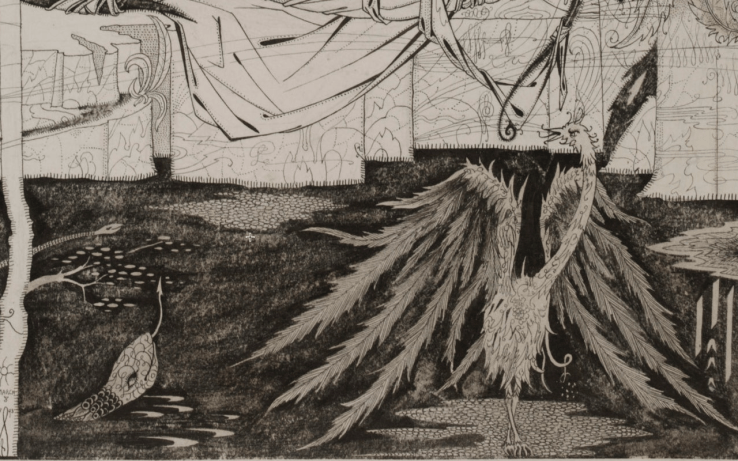
Beardsley has equalled Moreau in density and also—without colour!—his own form of richness and of confusion, making things out of lines and vice versa. Turning things into other things obscenely, giving new meanings to the word, metamorphosis as anarchy and detail as madness—all of Beardsley’s themes tumbled together—gawky erections that disappear out of sight, snakes, spiders, satyrs from a different world of myth entirely, clothes as intricacy and prison, acting like tourniquets on the flesh. The overpowering sensation is the fickleness of matter, solid one moment and a beguiling scribble the next. Stringy birds deconstructing themselves into individual feathers, snakes made of curlicues slithering through viscous liquids, and really monstrous forms whose eyes are fringed with rows of tiny breasts like Diana of Ephesus, or tiny growths like leprosy or testicles, whose tufts of hair are like lines gone completely crazy, a trap for perception rushing everywhere or nowhere. Arthur looks sideways at the graphic riot as if it is all a hallucination he has had, not a comforting thought because it means he is trapped in the web.

8b beardsley lounging figure copy

8a beardsley lounging fig det copy.png

There was a way out via a simpler printing process that allowed you, if you gave up subtle differentiations of tone and texture and settled for black and white in their full crudity or purity, the chance to reach bigger audiences much more cheaply. Beardsley found his way there via his biggest project, a commission to illustrate Malory’s Morte d’Arthur with an incredible plethora of 350+ separate designs which became a laboratory for simplifying without giving up mystery and power, an effort which offered him a vast field for subversions, antagonising William Morris who accused him of plagiarism, seemingly unaware of how radically Beardsley overturned Arts and Crafts ideals. Beardsley’s knights set off a disruption like a flurry of shrapnel—leaves, shields and oversized thorny stems all slicing, chopping and piercing their way through the mellow world of the past.
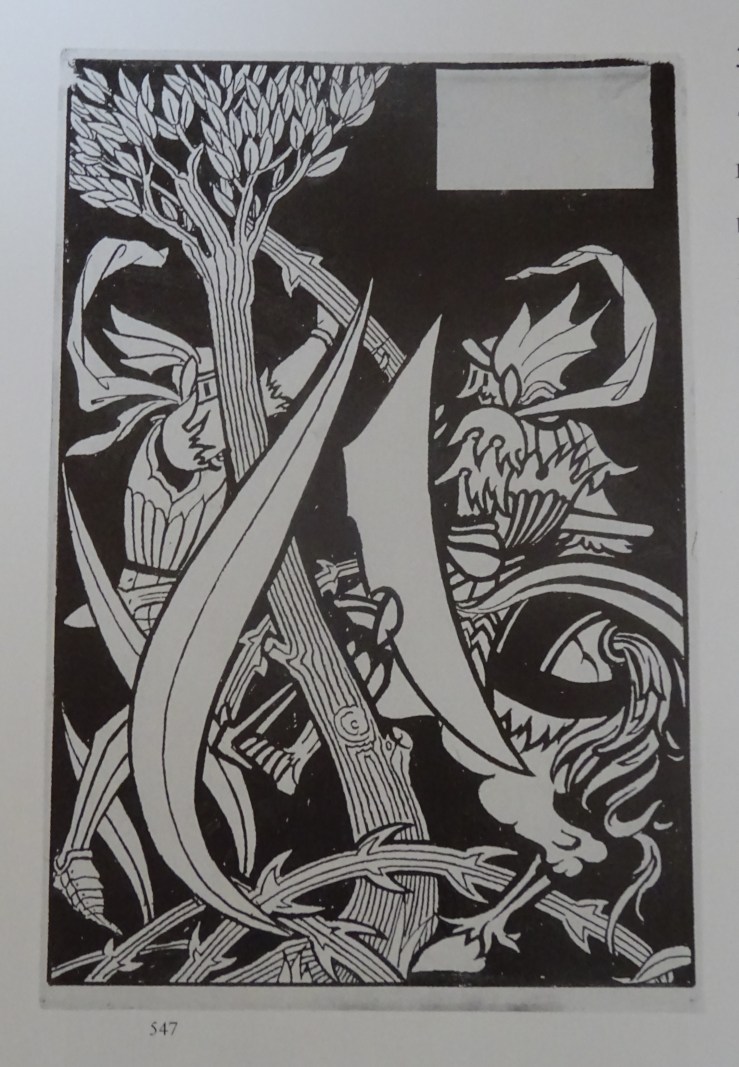
9 DSC04192 beardsley malory 2 fighting knights Z547 copy.jpg

For the publisher of Malory he designed an icon based on a pun. Dent, the publisher’s name, became the dandelion’s tooth and in Beardsley’s hands the prong of a phallic explosion observed by an unlikely serpent.
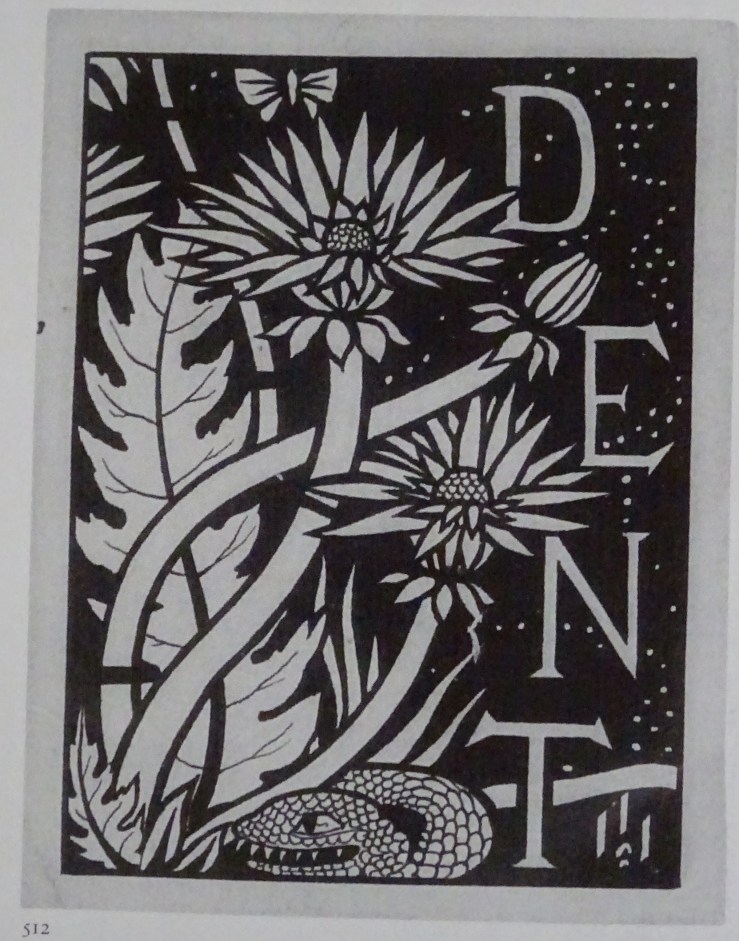
10 512 dent title page icon 5246

Further unlikelihood in pagan youths, pure immaturity instructed by satyrs who only belong in Malory as general disruptors of Christian principles.

12 DSC04628 beardsley malory naked boy leaning on fountain Z687 copy

There’s a whole category, calligraphic grotesques., which Beardsley produced on demand for Dent in years overlapping with the work on Malory, mostly small designs which are some of the purest expressions of his kind of iconoclasm, images where every feature is senselessly perverted into something else–eye for mouth, eyebrow for moustache, lips for eyes, breasts for horns, leaves for hair, face for chest and curlicues throughout to undermine the last illusion of representing anything sincerely or consistently.

13 DSC04226 beardsley bon mots grotesque head breasts for horns face on chest Z709  copy.jpg

Reptilian foetus-forms keep it from seeming real play. Innocent designs are few and far between, and even they upset things by turning the lower half of a cheery face to opposed 3’s lying on their sides.

13a DSC04287 beardsley bon-mots calligraphic grotesque Z763 copy

13b DSC04251 beardsley malory capped head gazing at fish Z730 copy.jpg

Finally, we hit on a scrap of harmless peacock fluff, but it too conceals a plump Wilde-decadent.

14 DSC04284 beardsley bon-mots large peacock feather Z765 copy.jpg

The later Beardsley went through the most astonishing series of style-shifts. Each new commission seemed to provoke another twist of the late style: The Rape of the Lock prompted a fantasia on the Rococo, with a sub-species consisting of welters made entirely of dots, a new orthodoxy for rendering lace or reality at its most intricate, in tapestry, upholstery and foppish dress. Next come the Lysistrata illustrations where the erect penis finally has its day, in which all mystery has departed and the idea of flesh is flattened.

The last project Beardsley worked on was an edition of Ben Jonson’s bitter, disillusioned play Volpone, or the Fox about a miser’s corrosive progress. Beardsley took this as a chance to send up the pompous version of Baroque, piles of fruit as imposing as cannon balls, satyrs as thick as oak stumps. The single fresh note in this heavy world comes in a hypnotic design for the cover, which he drew first in black and white but always meant for transfer into its opposite, turning light to dark and vice versa.   The black and white version (which I only heard about when I had long known the gold on blue result) is much crazier, jumping with demented motion, a jitter missing from the printed cover.

16 volpone black white DSC05287

The cover, a brilliant disintegration of Baroque continuity, translates pomp into a storm of fragments, but feels as if, if you worked at it, you might be able to cajole all the confusion and repetition to fall back into its proper places. But why would you want to do that? Isn’t the lumbering old Baroque better as an explosion than as the symmetrical reassurance of the old order? Brilliantly, the new cacophony consists entirely of recognisable elements of old conventions, which Zatlin suggests Beardsley meant as the phantasmagoric flashing of the fox’s tail.
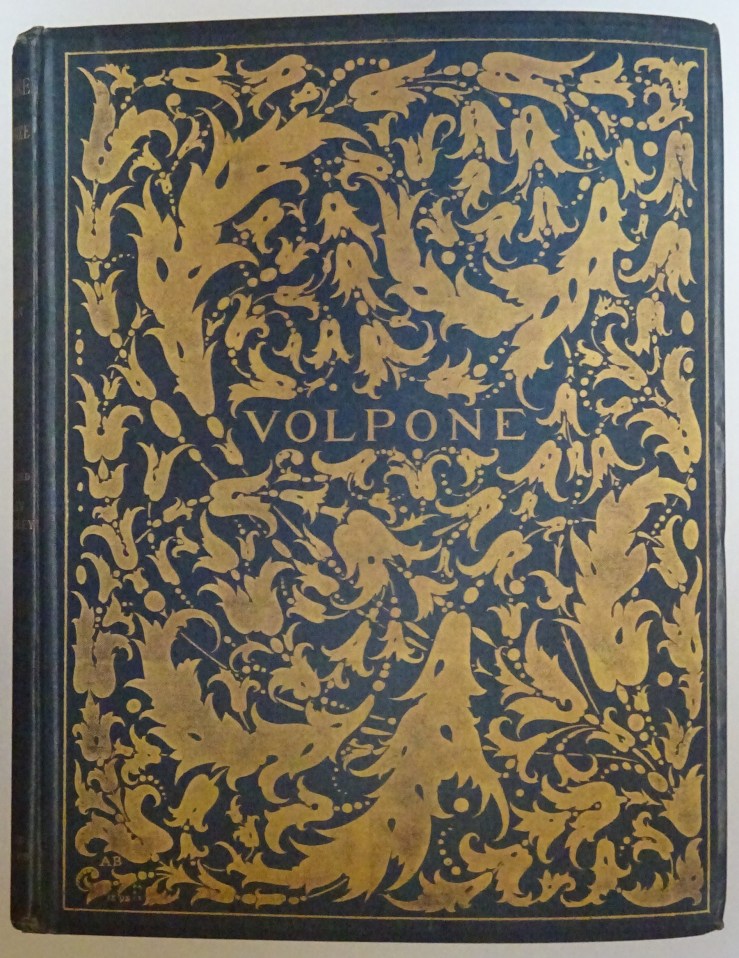
17 volpone blue gold DSC05290.jpg

And if you let yourself sink into it, you find there are even more frantic jitterbugging couples here, like the pair standing on V O L P.  It’s a fertile field for hallucination, full of birds, mammals (including sharp-nosed foxes) and who knows what else, filling all the left-over dark forms.

To get these effects you need to read the blue as solid forms, and the gold as background or surrounding void, as I forgot to say clearly enough.
Plans of temples: appendix to ‘wandering in a wilderness of moss’

dhamnar fr NW brickdust version.jpg

Dhamnar, complex of shrines from NW with recent brickdust coating


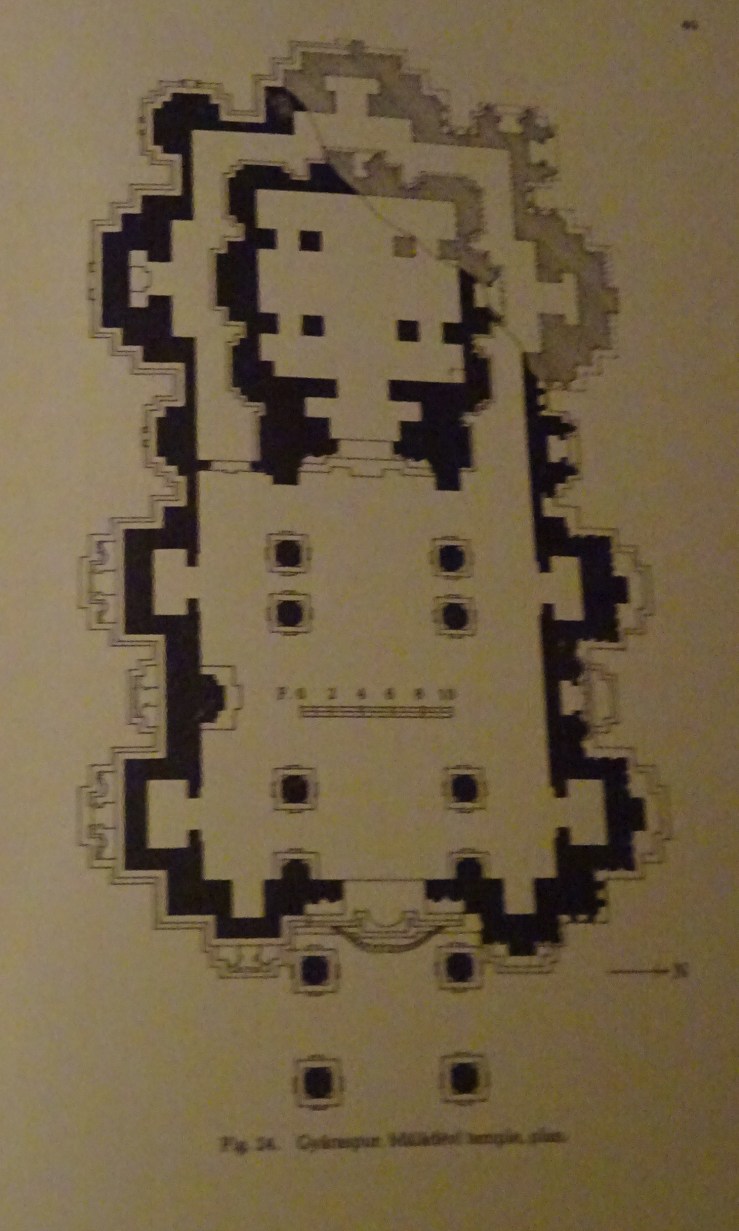
1 gyaraspur maladevi plan DSC04894

Gyaraspur, Maladevi temple, plan with the cliff that hugs the building on its right flank entirely omitted, and the upper right corner, a part of the building which does not exist, because of the intrusion of the rock, filled in in ghostly form as if it had been there at some time in the past.


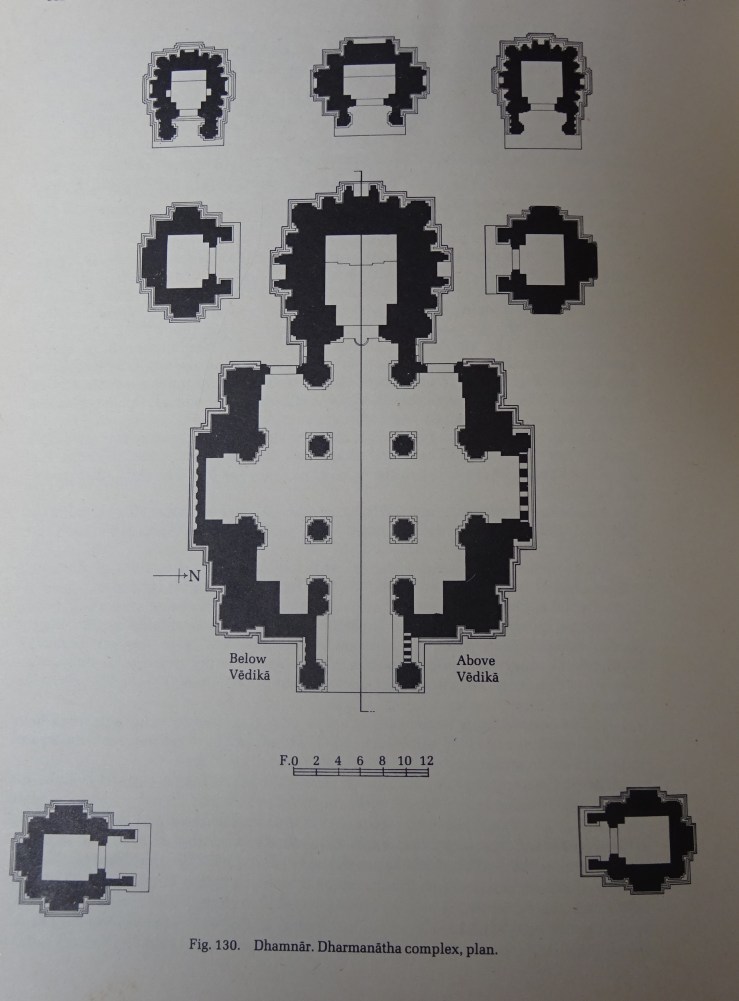
2 dhamnar plan DSC05139.jpg

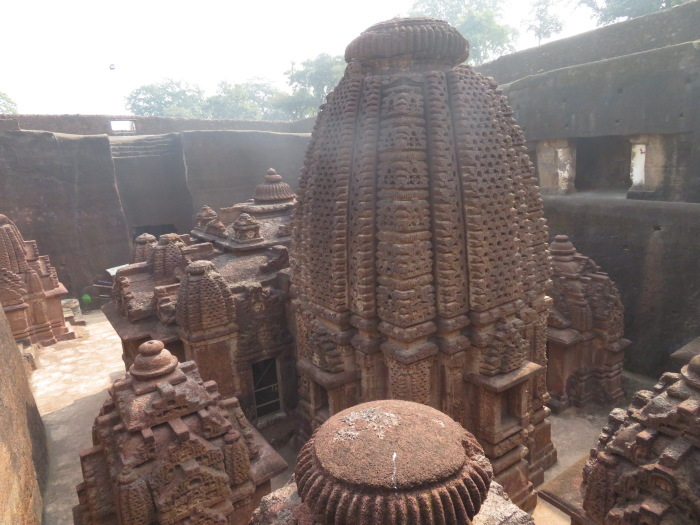
Dhamnar, Dharmanatha complex, plan of main shrine and seven sub-shrines, shown as if they existed in a wide empty space, though they are hemmed in on all four sides by the high walls of rock left by the excavation of the temples from the rock that formerly filled the space which now holds the buildings.

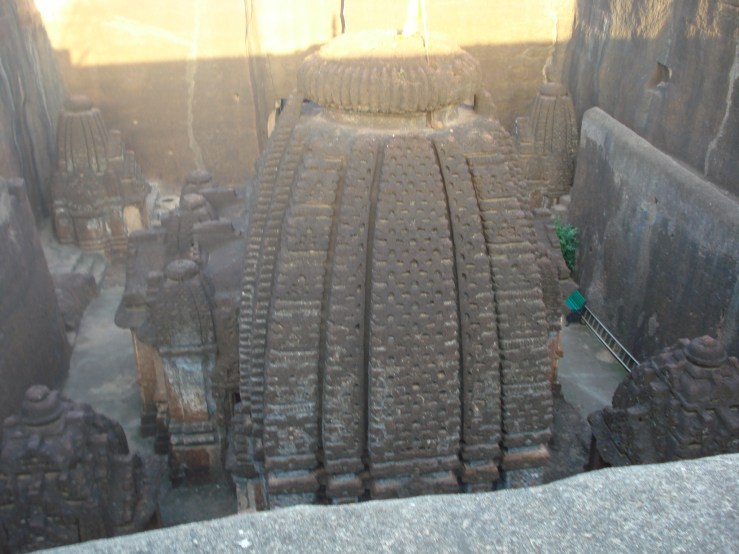
Below:  We are standing on the rockface at the top of the plan, looking east over the complex in its pit seen from above.  The tower of the main shrine is nearest to us.  Four of the small shrines are visible, two at the top, two on either side of the tower.  The three shrines across the top of the plan are not visible; to see them we would need to lean over the ledge in front.


Dharmrajeshwar fr W and above 5


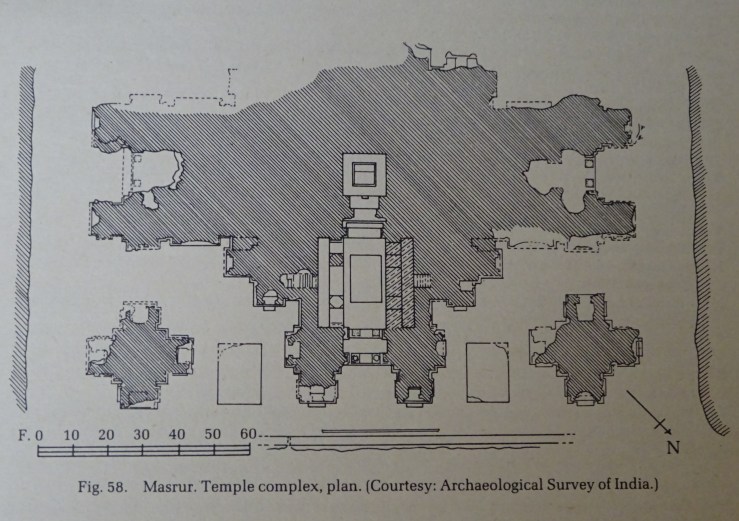
Below:  Masrur, plan of the unfinished monolithic temple

3 masrur plan DSC05128.jpg

There have been studies of how this project would have been extended further, based on existing symmetrical temples.


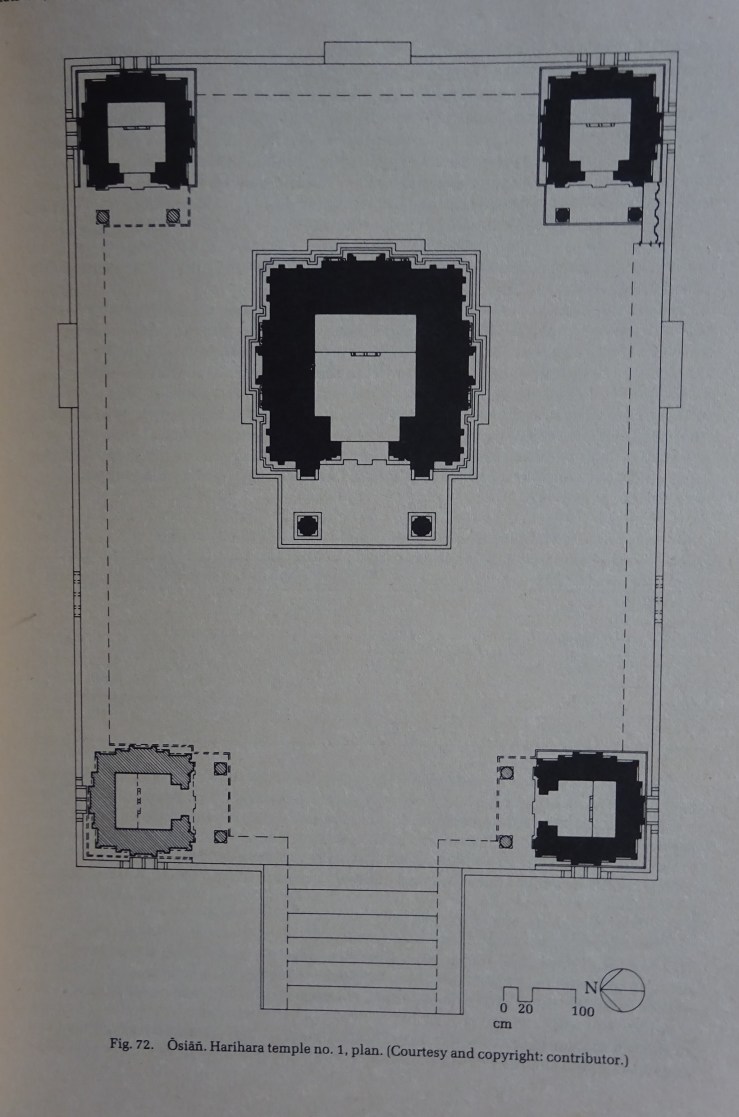
4 osian harihara 1 plan DSC05067.jpg

Osian, Harihara temple 1, plan. At some time in the past the fourth sub-shrine, in the NW corner, has been leveled. leaving a poignant vacancy that the visitor fills in or just feels the ache of, and appreciates the plan all the more through its disruption.  Only one of the sub-shrines keeps its porch semi-intact, and there are other anomalies (missing pediments and images etc) that are brought out more strongly by the dispersion of the plan, which draws attention to the isolated, widely separated parts.


5 osian harihara 2 plan DSC05075

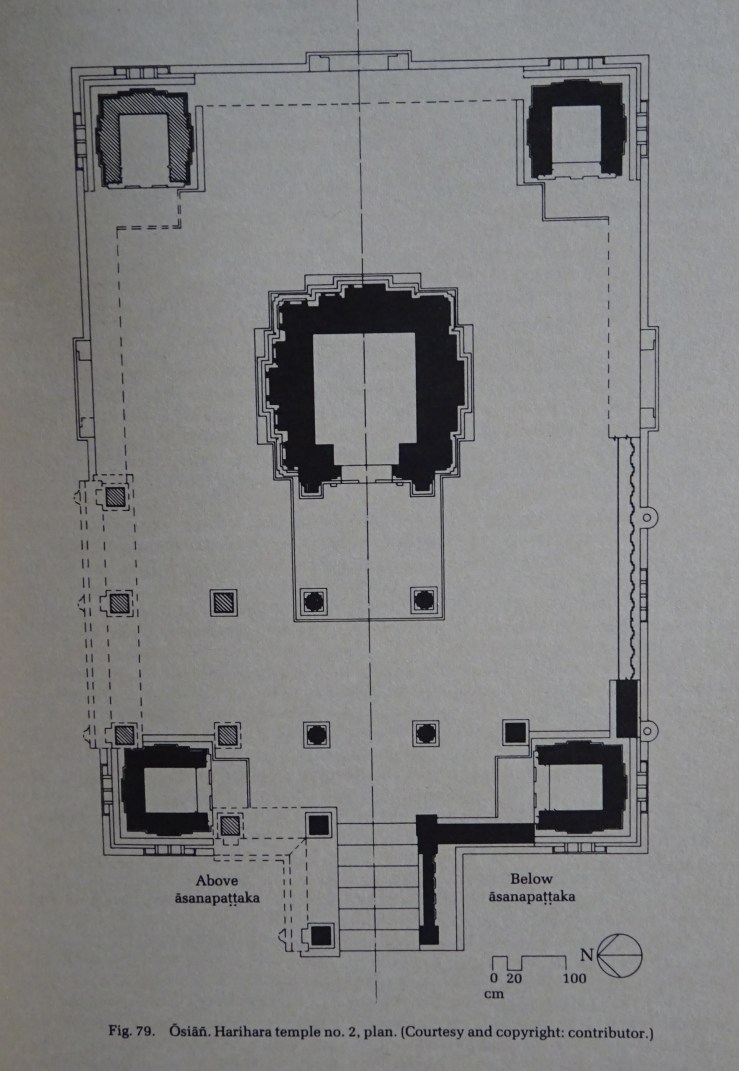
Osian, Harihara 2, plan.  Hard to appreciate the similarity of this building’s plan to the previous one.  The scale of the colonnade that turns an empty court into a large draughty hall is so unexpected and out of keeping that everything is changed utterly.  But this project too has to cope with incompleteness, and feels just as much a ruin as Harihara 1, but not a peaceful one this time.


6 osian harihara 1 platform W wall NW corner niche ganesha DSC05130.jpg

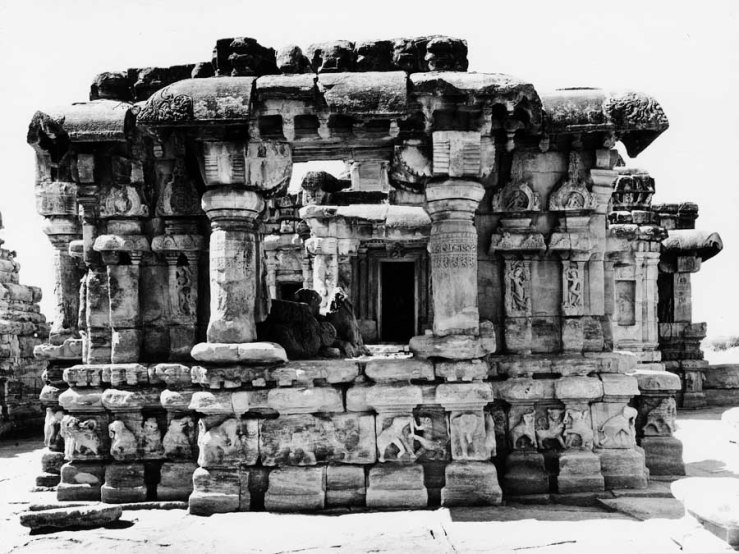
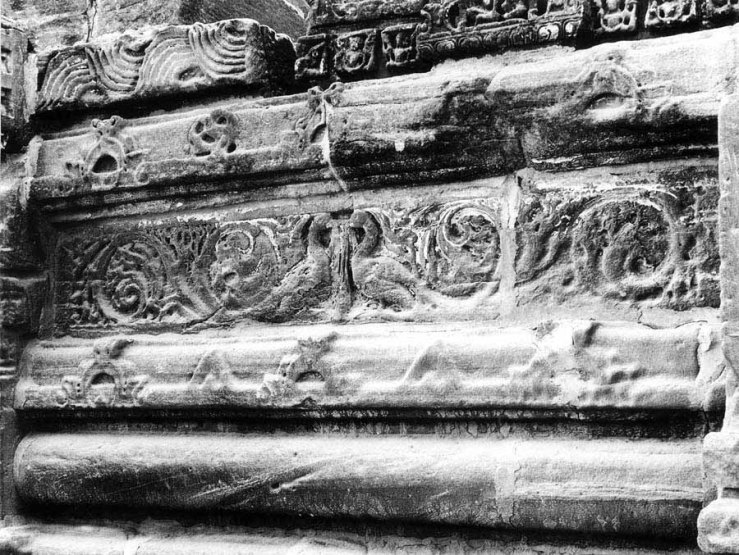
Osian, Harihara 1, jagati (platform) base.  This surrounds the whole site with carving of incredible richness and raises its little shrines to visionary heights.


7 osian haihara 2 platform S wall SW corner niche varaha DSC05134


Osian, Harihara 2, jagati base. Another powerful foundation something like a fort.  Very near the preceding temple.  The habit of Indian rulers of endowing whole cities of temples, very rich and sometimes almost indistinguishable, remains unfathomable to me.  Pattadakal and Osian are prime examples and there are others.  Is it the old idea of creating heaven on earth?


8 kanchipuram kailasanatha temple plan Screen Shot 2020-07-29 at 16.40.05.png

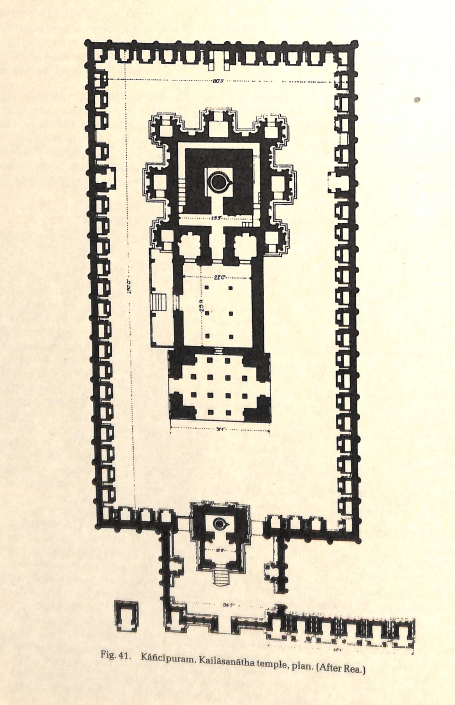
Kanchipuram, Kailasanatha temple, plan

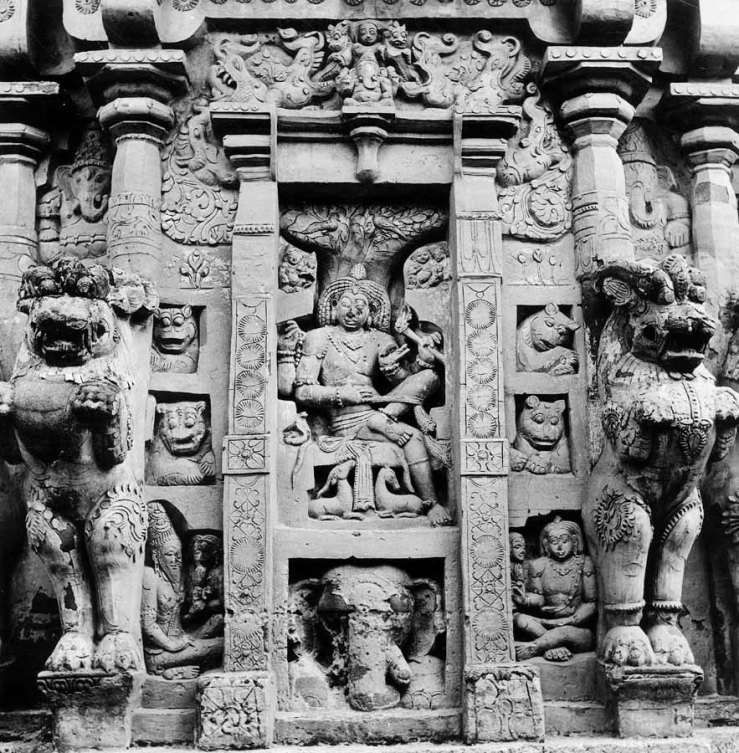
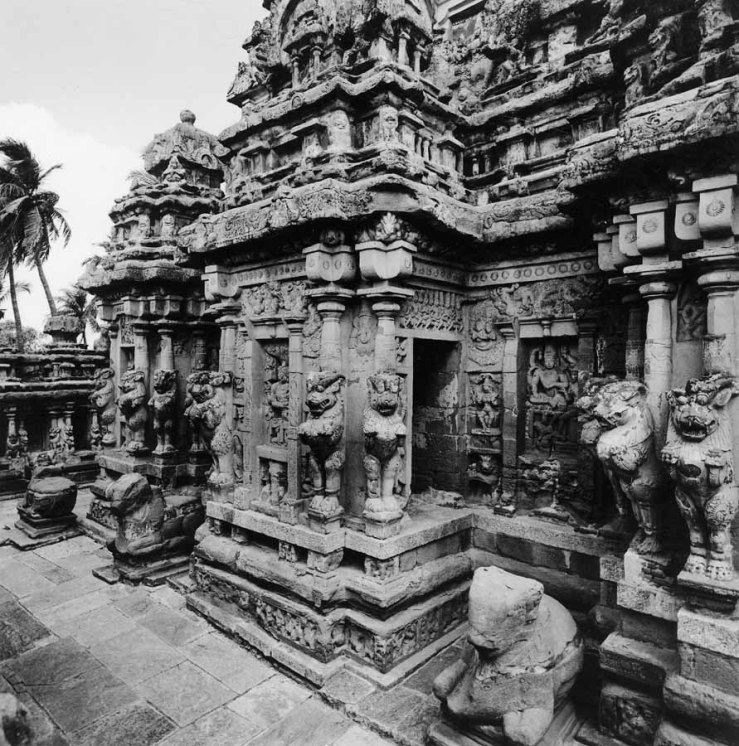
The heavily indented wall at the top of the main mass creates some of the most powerful effects in Indian architecture, weaving in and out in continuous zig-zag movement to join a series of sub-shrines to the sanctum at the top. I don’t know how these apparently separate spaces work or how you get into them, but the sculptural effects as you circle the building and get temporarily lost in cavern-like narrowings guarded by nrsimha-beasts with monstrous eyes, claws and feet make a wonderful and fearful experience like one of Blake’s alarming epics brought to life.

Indian temples: wandering in a wilderness of moss, and the way out

malliarjuna nandi mandapa 20157 copy.jpg

I am looking for a way to describe the last two months of activity which have sometimes felt like being lost in a maze, or like falling down a hole into another world to which there is no end, and no obvious structure, that has you wandering in a wilderness of moss, a wide expanse of the tiny, where an obsession with detail makes you lose sight of the larger themes from which you originally set off. The series of objects, in this case Indian temples, keeps unfurling and leading you on, unsure whether it’s a boon or a curse that the series has no end or obvious shape.

The model lurking here seems to be that of  finding forms concealed in the ground itself, discovering buildings in the living rock like the figures Michelangelo senses waiting to get out of the stone block, buildings which combine the qualities of sculpture and architecture, which you release from captivity rather than invent or devise according to the rules of a human craft.

01babel

Bruegel’s Tower of Babel is not generally considered a mythological painting, but it taps into primitive ideas about the connectedness of different life forms, in particular of human societies and mountains, combining god-like scale and a multitude of petty human devices like cranes and hoists.   It depicts a faltering technology and a huge and concentrated effort that will set human civilisation back a stage or two via burgeoning misunderstandings. But the fact remains that someone has imagined a symbiosis, though in ruined form, between geology and building, the one growing into and out of the other, like a weird actualisation in the 16th century of the creation myth in which the largest distinct natural form, a mountain, gives birth to the full later complexity of species and cultures, like a comprehensive explanation of what we are all doing here.

Tremors in consciousness provoked by that much later composition together with the Cambodian creation stories can help us understand what Indian architects might have been driving at in searching out solid masses of rock near the surface, signalled sometimes by the caves already tunnelled through them by slippage or erosion, in which with minimal removal they could discover buildings.

It was never a high proportion of Indian religious buildings which were made or half-found In this way, but they had an imaginative force out of all proportion to their numbers. Whenever you come across them, they take you back to the mythical origins of architecture, spaces found not made, and then brought up to the surface and into the light. That is the direction we imagine such spaces heading in, but for us the excavated temples usually speak strongly of a darkness we have mostly left behind, which it seems part of the task of the temple, whether rock-cut or not, to drag us part-way back into.

1 gyaraspur patch 188+ det L corner & porch cows eye gable over low niche ar_003046 copy.jpg

The first time in India our only rock-cut temple was only partly discovered in the hill. Most of it was added onto the cave-bit, so the whole effect was like the tower of Babel, built bits merged with more primitive elements to make a patchwork whole, all of which resembled bricolage, a hybrid tumbled together like a rock fall, not entirely stable.

The temple lay at the foot of the hill as if partly hidden by scree which had slid downward as the hill eroded. The entry porch and the mound rising behind it didn’t look as if they were all in the right order, but scrambled, as in a half-collapsed structure.

1 gyaraspur rock 200 NE corner fr slightly above joined to rock R ar_041227 copy.jpg

Crawling round the interior was a powerful experience. I’m not sure you could follow the ambulatory passage the whole way round. At a certain point your way was entirely cut off after you had crouched or crept through the lowest bits. Certainly you were bothered by the bees. They had set up their hive in the furthest reaches and came and went continually, their buzzing amplified by the vault.

The plan in the Encyclopaedia of Indian Temple Architecture gives such a bland idea of this dangerously impeded interior and doesn’t attempt to show architecture turning abruptly into crags along the temple’s right flank or at its west end.

1 gyaraspur rock 191 det rock at SW corner ar_041229 copy.jpg

But the whole force and value of the Maladevi temple at Gyaraspur, which makes it a great beacon among all the buildings I have seen, is this uneasy truce between the violence of geology and the ingenuities of architecture.

If I had it to do all over again, I would go on to Gwalior (as we did) and make a stop at the little Caturbhuja shrine in the Fort (as we didn’t) to gauge how the raw power of rock makes itself felt in a rock-cut building the size of a plaything.

2 Dhamnar Dharmanatha temple overview of superstructure fr SE 81830 copy.jpg

Next I would stop at Dhamnar (a substitute for the grandest of all rock-cut temples at Ellora), an instance of the fascinating type that finds an entire world below ground level, ground level which still exists on every side at Dhamnar, where eight temple buildings form a tight cluster, a main shrine and seven complete children of the parent, which each possesses all the parts of a temple on a reduced scale.   Or I would have done this in 2001, but I am not sure I would now, because this complex has apparently been renovated by drastic cleaning and the addition of a protective coating that contains a lot of brick dust, which gives it an orange colour, most un-stone-like, like the healthy glow favoured by failing Presidents.

2 Dhamnar Dharmanatha shrine 1 at SE corner fr NW 81886 copy.jpg

Even in the old days the buildings at Dhamnar were rough and raw in a wholly different way from Gyraspur. Sculptural detail had the smudged look of attempts in very hard stones like granite, but here it was the stone’s softness that had made it easy for time to erase all sharpness, until you felt the day looming near when it would all disappear.   Hence the well-meaning renovator, who didn’t want to hear that he had replaced a beautiful ruin with a lifeless model born yesterday. Did he know how the building was made?   Turning it to brick was such a cruel travesty.

3 masrur 3 overview fr SE 58128 copy.jpg

My next stop (on my would-be journey) is safe from such destructive interference because it was left so incomplete that the effect is like camouflage. In this group of magical buildings it is perhaps the most magical of all.

It is like a sketch for a large temple complex more begun than completed, blocked-in lightly across the whole site, so it is all there and full size, but barely detectable. Perhaps uniquely in the whole history of architecture, this temple group at Masrur in the Himalayan foothills preserves the natural inspiration of the building and even the full value of its magical materials before they are spoiled by being squared up and smoothed, yet conveys the entire architectural concept in a shapely and complete form as well.

3 masrur 12 det sloping sikhara 58095 copy.jpg

It is both a building and a vivid landscape, a mountain range bristling with crags and a symmetrical city of towers, an ideal vision like a Chinese landscape representing heaven, and a whole world of natural rock always entirely itself and (almost) nothing else, the most natural as well as the most perfect temple.

3 masrur 2 overview fr S 58130 copy.jpg

Some readers may think they’ve already seen something like this in their local zoo, artificial crags constructed for mountain goats to climb on in captivity. But the distance between constructed and actual crags is unbridgeable. Not that hybrids can’t contribute something to the discussion, like the miniature rock-cut pavilions at Mamallipuram lined up in a row as the outcroppings seem to have allowed, with the quaintest indication that these were carved from the top down and (in at least two of them) left deliberately incomplete so you couldn’t miss the point. Bhima ratha and Valayankuttai ratha turn back into wild rock for a last few moments before they reach the ground, which makes them at one and the same time, levitating architecture and a natural growth rooted in the earth, a botanical/geological marvel giving birth to a strange child, the phantasm of civilisation.

Instead of purely human constructions these are Eternal Forms like those which emerge on the walls of caves as a teeming population, buildings something like creatures with their own internal principles of life.

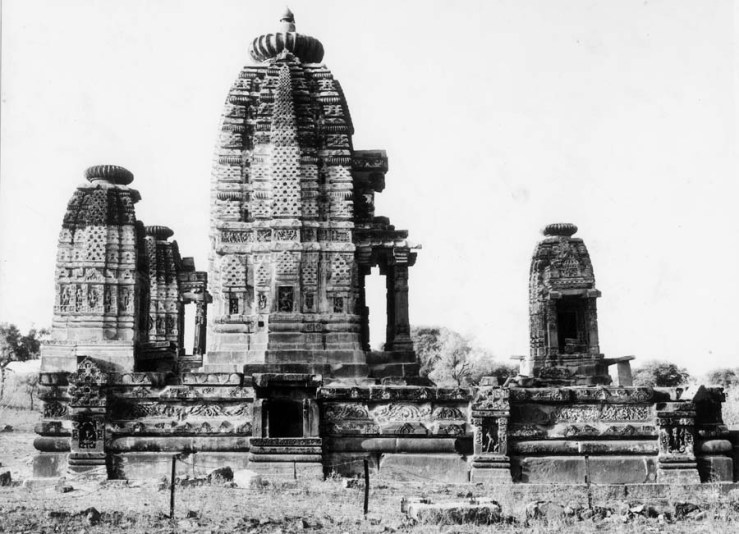
In a sense it’s wonderful there is no end to the territory and no single logic according to which it is laid out. At the other end of the field of possibilities from temples camouflaged as mountains are seemingly overplanned complexes leaving nothing to chance, which look in plan more like wiring diagrams than rich plastic compositions binding together their widely dispersed elements. Among examples of this type, both monotonous and scattered when seen first in plan, the so-called Harihara temple 1 at Osian in Rajastan stands out, ‘so-called’ because the interesting dedication to Harihara the bifurcated deity, who suits the site which can’t consolidate or make up its mind, this name has been retracted for something blander.

4 Harihara temple 1 overview fr N 52947-1 copy.jpg

The bases of Indian temples are one of their most distinctive features, elements more central to the building’s way of being than any equivalent in Western buildings, elements which often attract careful diagrams in the Encyclopaedia. Bases come with many stages and bristle with Sanskrit terms in the Encyclopaedia entries.

5 harihara 2 jagati E face det raking 57125 copy.jpg

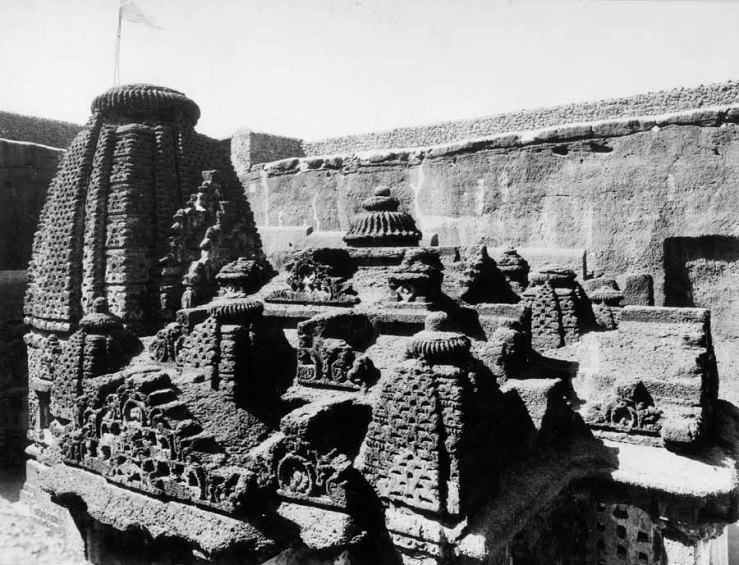
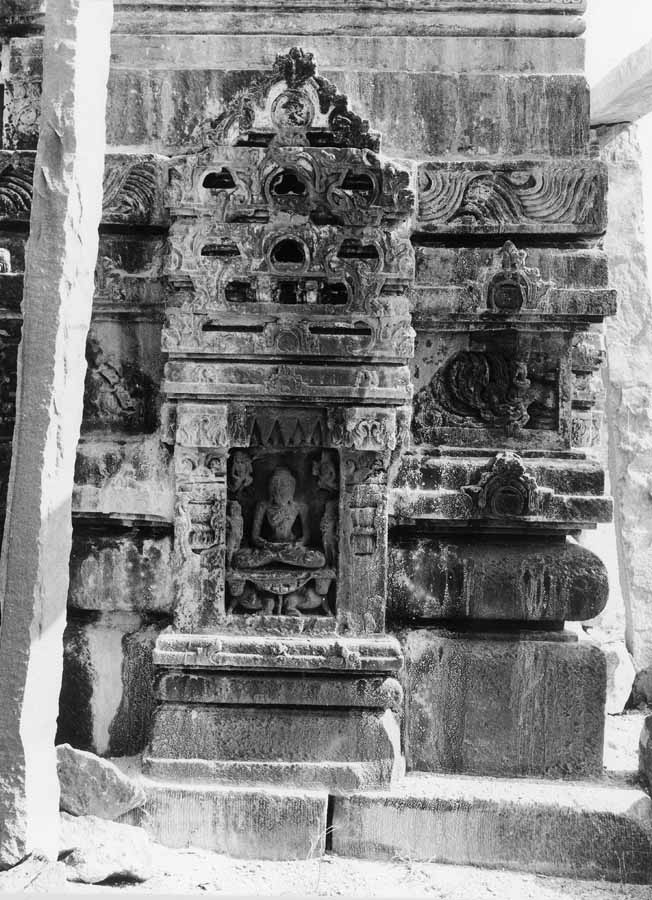
The platform-bases of both Harihara 1 & 2  pile up seven distinct stages, like multi-storey structures in miniature. all of which is distinguishing the building from its setting in the world and asserting its essential complexity. The platform-base at Harihara 1, which is like an elephantine enlargement of the bases of its component shrines, has the unity and coherence of a whole symmetrical cosmos made of clearly marked layers and dotted with architectural miniatures, niches which contain their own versions of walls, roofs, thresholds, openings and inhabitants. The resident spirits of the Harihara temples are the figure sculptures which appear three to a side on the walls of the platform, and then at least five to a side on walls of each of the five shrines planted in the peculiar symmetrical system on the roof of the platform.

4 Harihara 1 SW devakulika overview fr NE 57612 copy.jpg

The Encyclopaedia  includes neat little charts of the sculptures placed on the four cardinal aspects of the building, charts which take for granted that these layouts carry crucial meanings. So I found myself becoming obsessed with pinning down who was looking out from where, as I reconstructed a visitor’s journey around this multitudinous complex.

To begin with, this exercise required being sure of the compass points. Hindu temples normally face east, contrary to the usual orientation of Christian churches. Anyone who deals with the plans of western religious buildings gets used to finding the east end at the top and the west entrance at the bottom, north to the left, south to the right. With Hindu buildings these norms are reversed. Except that a few important Eastern buildings, Angkor Wat, for instance, Kailasa at Ellora, and Harihara 1 and 2 at Osian, face west.

This anomaly has caused confusion in the Indian Encyclopaedia, where the charts of sculptures on the Harihara shrines show the sequences of deities on all four sides of the platform and the five shrines reversed from their actual order.

0 R

I started out not knowing what some of these deities should look like and only began to notice that they weren’t in the right places when the elephant’s trunk appeared on Kubera not Ganesa, and the boar’s snout on Buddha not Varaha. At this stage it felt exactly like solving a puzzle, and no one would believe the satisfaction I got from putting Buddha in the right place. But Buddha on a Hindu temple? Was it tolerance or co-opting?

How pleasing to learn that the very same order is repeated on Harihara 2, not the attitudes and emotional tonalities or relations between other creatures in the scenes, but the basic sequence of deities was the same, so the content must be at some level deeply valid, and therefore it was probably a structure worth pondering. It took a long time to dawn on me that Harihara 2 also has the same floor plan as Harihara 1, but with a large intruder plunked down in the middle of it, an overscaled colonnade made of diverse column-forms which allows the roofing-in of the open space between the shrines.  I felt let down by Michael Meister, my favourite among the different Encyclopaedia authors, above all for his responsiveness to natural settings and his appreciation of all kinds of architectural novelty. Why didn’t he announce the startling alteration in Harihara 2 more emphatically?

Why didn’t he make plain how radical it was to stick this heavy awning on an essentially outdoor space? And why weren’t there any photos showing how the new elements collided with or related to the existing shrines, which they treated as buildings within a much larger building, where they were now lost or marooned or holding court in a sort of surreal parody? Which was it? Were contradictions exaggerated or suppressed, enjoyed or disguised out of existence? One of the really explosive moments in Hindu architecture had been slipped past us unawares, a missed opportunity which made me wonder if my hero hadn’t been paying attention. But there was proof that he admired these buildings tremendously, so he had certainly noticed.

One of the pleasures of Harihara 1 is the assembly of five (four surviving) exquisite separate works into a new whole. Harihara 2 gives up those pleasures to make a more imposing singularity, or is it a more ungainly diversity? You would need to go there to decide which. In any case architect no. 2 wasn’t content to repeat. I still miss the photos capturing the bold new spatial effects where the canopy meets the shrines.

Your analogy or model for the process, that it is like solving or putting together a jigsaw puzzle of separate pieces, is faulty and much too confined for what is taking place, because a jigsaw has one answer and follows a narrowing process to a goal that is almost meaninglessly clear and definite. This other process is a loosening and tightening as you go, sometimes a limited task like identifying all the figures which swarm on the outsides of buildings, then finding that the sculptures on two related buildings follow the same sequence and can help solve each other, because different ones are recognisable in each, and others are obscure, and some are missing entirely, or not in their proper places but lying some distance away, like the semi-human creature planted temporarily in a blank space on the back wall of Harihari 1 at Osian (Harihara, who isn’t the single deity linking all three of these buildings–Harihara temples 1, 2 and 3–after all).

Chasing the Hindu stories round the outsides of these buildings can seem a childish activity. In truth we are now reduced to chasing them mainly through photographic archives of disconnected views, shattered but in some odd way a more continuously sensuous activity than many visits to actual buildings can consistently be. The photographer is making choices, continually selecting. And leaving out the wider context can result in more intense experience.

DSC05110.jpg

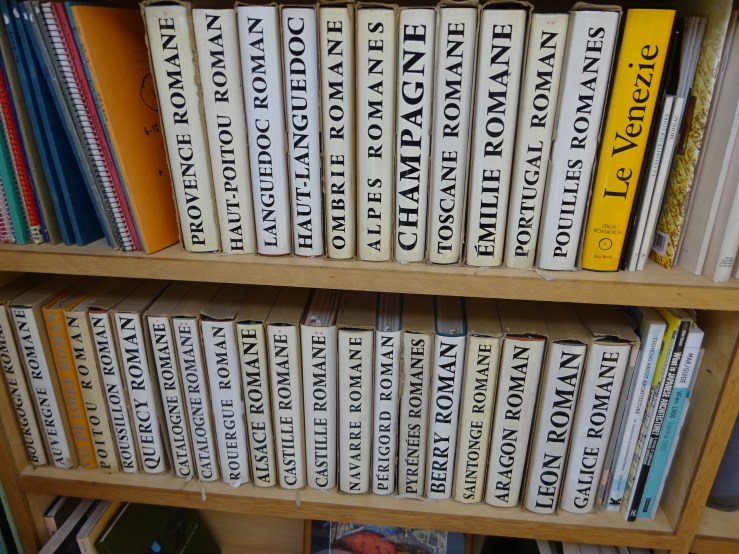
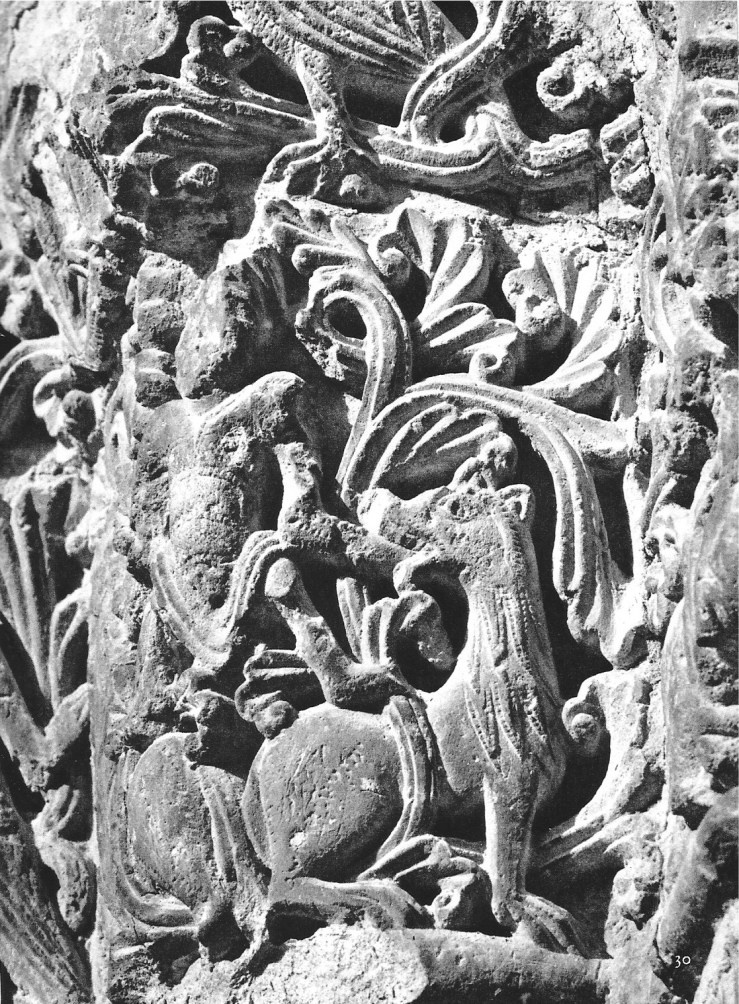
I find myself thinking of a remarkable French series that concentrates on obscure Romanesque buildings in obscure or at least very particular corners of (mostly) rural France. In some sense it is literally true that I have never been closer to the textures of carved limestone than when transfixed by the black and white photos in these modest-sized books.

‘Black and white’ isn’t good enough. These were images printed in heliogravure and bled off the edges of the page, leaving no room for captions or other distracting words diluting the confrontation with all the tones between light and darkness, glare and shadow in all their heights and depths, in a total concentration on the grain of the stone, the scuffs and breakages that describe its life over time, the contest between tools and the rock’s varying resistance, between the slow taming of mineral surface by wind and water, and the bursting forth of rude ideas about animal energy, and emotion crossing or breaking out on human features, all this filtered through a photographer’s eye, who’d been brought up on early modernism which had played havoc with religious belief.

zodiaque 4 copy.jpg

For the Zodiaque series of Puritanical (in the best sense) treatments of Romanesque buildings were the brain child in the first place of a single Jesuit monk, trained as an artist and a priest, who combined these two strands in strong forms to produce (with committed collaborators) one of the most compelling visions of a phase in the story of art, especially vivid and alert to forces beyond a narrowly rational view of human culture and especially of animal life, a spirit it would be apt and inspiring to bring to bear on Indian architecture and sculpture of an equivalent period to the French Romanesque.

Perhaps our best hope of such an encounter lies in the photographic archive of around 120,000 images of Hindu temples assembled by the American Institute of Indian Studies, mostly in the late 1960s and early 70s. I haven’t tried to pin down images to particular photographers but have picked out a few that come closest to those in the Zodiaque series, especially the volumes in which Dom Angelico Surcamp took a sizable part.

To try and distinguish different photographers’ contributions in the Indian pictures is a project beyond me at the moment. So far I’ve barely thought of these Indian photos as works in themselves, but used them to understand the buildings.

But the Hindu stories—there I am still at an early stage. I come across ‘Natesa’, and after 4 or 5 occurrences I realise it’s a name for Siva, meaning ‘Dancer’, which is attached to him when he’s quelling demons by dancing on their heads.

I keep seeing Nrsimha, a god in the form of a man-lion, with a much smaller creature– human with an animal head?– the images too ruined and me too inexpert to make out these figures clearly. Lion-man seems to be tearing the little person open and letting his innards spill out. The lion-man must be an aspect of one of the main gods, given the prime positions he is awarded. I am putting off looking him up.

I get a kick out of Siva dancing on the heads of demons. I am fascinated but appalled at Nrsimha sitting there calmly eviscerating a child-victim. A few days ago I watched a film which E soon realised she didn’t want to see called Map to the Stars that was loaded with the exhilarating crudity of Greek myth. Children were doing awful things, setting fires in which they accidentally burned up themselves as well, strangling smaller children across their knees (cf Nrsimha) in Portacabins. Therapists acted out their clients’ fantasies, crouching over them like predators. These events took place mainly in Hollywood, and star maps showed you where the huge egos of film had their castles. Stardom was obscene and mysterious, yet had some connection to the heavens. All the grisly violence wasn’t just senseless. Hindu gods can also seem quite un-benign, but you need to know about them, and feel as you learn that you’re in touch with something that matters.

I am late realising that E and I are embarked on similar quests. She is working her way through a limited number (a quarantine, as it happens), 40 holy men (including only a token scattering of holy women) from all over the world, a number to which there is an end, which she can break down into a compassable number of distinct tasks and can even take a week off to do more pressing work, an inventory of an existing population, the furniture and ornaments of the house, or something which has a fixed terminus, like a gigantic shopping list, a survey in its way of all creation, but one which has a submission date by which it will be done, whereas mine keeps expanding from the dimensions of a single blog post to that of a book, or a couple of them, as if in cataloguing certain contents you went on discovering further series of rooms in a ramifying structure which kept on growing like Topsy, like a god who developed new limbs to accommodate new functions or new tasks, which were or became new identities, so the total number of gods might range anywhere from three to three hundred million.

[Excursus on Kanchipuran and Pattadakal] Here was meant to come a brief treatment of the Kailasa temple at Kanchipuram in Tamil Nadu, a fascinating instance of a building as a mountain that I was put onto by a witty drawing of my friend Adam Hardy’s, which clarifies the organisation of this super-intricate, angular ‘mountain’, built of an impossible number of sub-units each complete in itself with a final result like an enormous, many-faceted lump of quartz. The drawing brings out the cartoon-like quality in the battery of horrific and comical lions who follow the twists of walls intensely indented, like an abstract rendering of rocky crags.

Kanchipuram Kailasanatha vimana S wall devakostha 3610.jpg

I intended to follow Kanchipuram with a treatment of the Virupaksha temple at Pattadakal, so the imaginary journey would begin and end with buildings I had actually visited, and Pattadakal would allow a final summation of the plenitude of Indian architecture, the whole human and natural worlds collected and summarised on the outer surfaces of a single building.

0 R

This plan came a-cropper through a discovery that seemed at first a miraculous validation.  Somehow I came across a description of Ellora, the biggest and best of all rock cut temples, which derived it from the very buildings at Kanchipuram and Pattadakal I had chosen for purposes of my own. The account was even embellished with a sick king and his fasting queen, like inhabitants of a fairy tale, and I was off on a lengthy burrowing in the complexities of Ellora, plentiful sculptures, decorative innovations (the Rococo many centuries before its time), undreamt-of forms.  Would I never be done?  Every ending sprouted a further beginning.  Except that this time the link between Ellora and the other temples was a fantasy, and the story of the building finished before its initial courses were laid, saving the queen from wasting away, was an opportunistic appropriation of an architectural paradox.

The number of interesting old temples in India kept growing and was the most numerous population anywhere in the world, which would only be manageable if I were 20 or 30 or 40 years younger and could fit in 5 or 10 or 20 annual trips to keep up with the expanding and deepening field. The Shell Guide to English Parish Churches might be the template – surprising it took me so long to notice the parallel, or Pevsner’s twenty-four years covering England which began at least ten years before it surfaced in a form visible to anyone else. In some sense this was the ideal ancestor, which kept popping up or beckoning, seeming to stand for any sustained human effort, a plan so ambitious it encompassed an entire place, a large island that resembled a continent, a task so huge it was probably not do-able. I set forth on my truncated version of such a task, consuming two years, not twenty-five, which still became a trap I was dying to get free of, as now I regretted being still a prisoner of Indian temples after almost two months.

The beginning of this obsession was lost in the mists of one of the intensest and at the same time blankest periods, when I could hardly leave the house or escape an isolation that would perhaps never end, except that here ‘never’ meant only a short span, a year or two until you inadvertently caught the disease you wouldn’t survive. Life had become both a nothing and a gigantic cosmic allegory, like the ones medieval folk went around thinking they had always been engaged in.

DSC05119.jpg

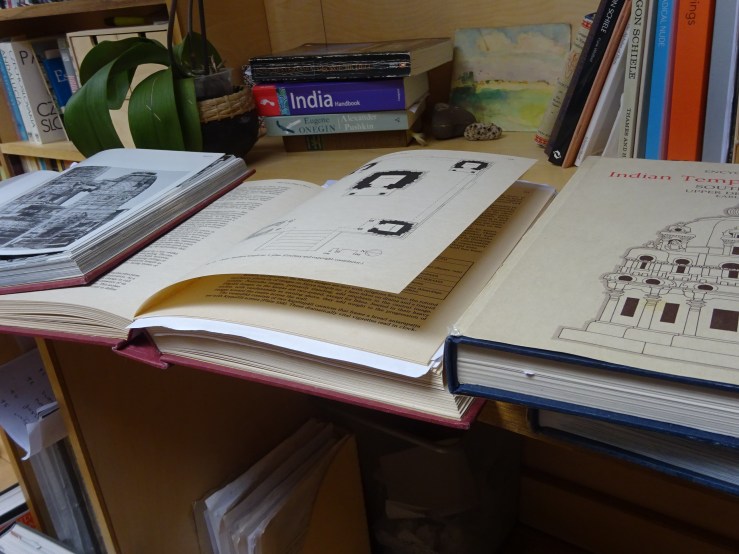
So that was a kind of template and its content was a series of temples, dictated by an unfathomably complex series of examples in a couple of books organised according to a series of local rulers who were locked into an extremely foreign geography or a history of exotic styles and the shifting stimulus of a big collection of images which all sat in four over-lapping volumes you kept picking up in no fixed sequence. Four was just enough to feel unencompassable like India, though it covered only two arbitrary blobs of territory over a not easily identifiable set of years Far Away and Long Ago. (The title of a book which bewitched me when I was just beginning to read on my own.)